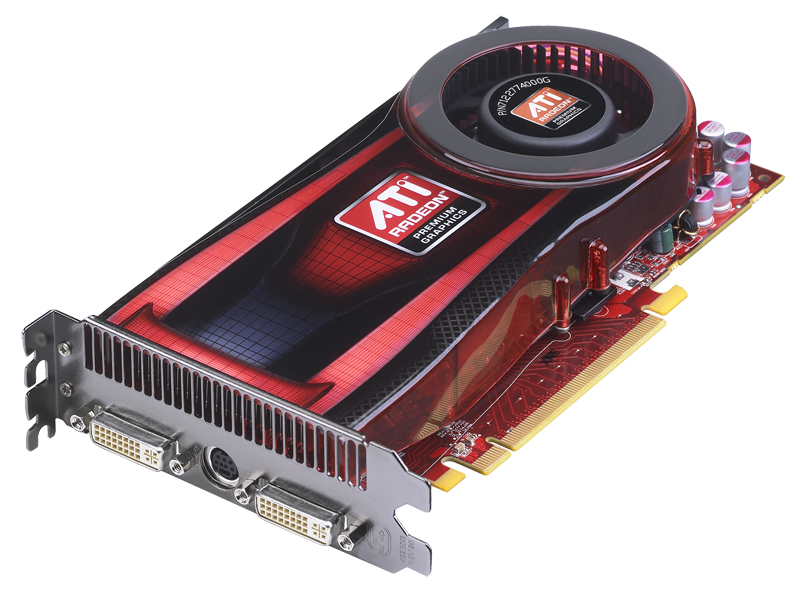
Radeon HD 4000 series
AMD graphics processor series with GDDR5 support
Advanced Micro Devices released the Radeon HD 4000 series in June 2008 under the ATI brand. Built on the TeraScale 1 architecture, these GPUs introduced GDDR5 memory and unified shader designs to compete with NVIDIA.
- First GPU series to support GDDR5 memory
- RV770 chip features 800 stream processing units
- Manufactured on 55 nm and 40 nm process nodes
- Supports OpenCL 1.1 for general-purpose computing
- Includes UVD 2.0 for hardware video decoding
What it is
The Radeon HD 4000 series is a family of graphics processing units developed by Advanced Micro Devices under the ATI brand. Announced in mid-2008, this lineup marked a significant shift in GPU design by introducing support for GDDR5 memory and expanding the count of stream processing units. The series covers a wide range of performance tiers, from entry-level chips for basic display tasks to high-end models designed for gaming and professional visualization. It implements the TeraScale 1 microarchitecture, which focuses on unified shader execution to handle various graphical workloads efficiently.
How it came about
AMD unveiled the foundation chip, codenamed RV770, on June 16, 2008, as part of its Cinema 2.0 initiative. The official release of the flagship Radeon HD 4800 models followed shortly after on June 25. This launch positioned the series directly against NVIDIA’s GeForce 200 line, which arrived in the same month. The development team focused on increasing parallel processing capabilities compared to the previous R600 generation. Subsequent variants rolled out through 2009, including mainstream and enthusiast updates that refined the initial design.
Inside the chip
These GPUs utilize the TeraScale 1 architecture, featuring unified shader cores grouped into SIMD units. The top-tier RV770 chip contains 800 stream processing units, a substantial increase from earlier generations. It employs a crossbar and internal hub for data movement, replacing older ring bus structures. A key innovation was the integration of a 256-bit memory controller capable of driving GDDR5 memory, offering high bandwidth. The chips also include UVD 2.0 hardware for decoding video formats like H.264 and VC-1, along with support for HDMI audio output.
How it was made
Manufacturing utilized both 55 nm and 40 nm process nodes depending on the specific model. The high-end RV770 and RV790 dies were produced on the 55 nm process, containing up to 959 million transistors. Later mainstream models like the RV740 shifted to a more efficient 40 nm process, packing 826 million transistors. Entry-level chips such as the RV710 used the 55 nm node with 242 million transistors. This mix allowed AMD to balance performance and power consumption across different market segments.
Where it went
The series powered desktop computers and laptops for gaming, media playback, and general computing. High-end models like the HD 4870 targeted enthusiasts who required strong 3D performance and support for multiple displays. Mainstream cards served everyday users, while entry-level variants handled basic desktop acceleration with low power draw. The inclusion of OpenCL support enabled these GPUs to assist in scientific software packages, accelerating certain computational tasks beyond traditional graphics rendering.
Versions and family
The lineup includes the RV770-based HD 4800 series, the RV790-based HD 4890, and the dual-GPU HD 4870 X2. Mid-range options like the HD 4700 series used the RV740 or stripped-down RV770 cores. The HD 4600 series relied on the RV730 chip, while entry-level HD 4300 and 4500 models used the RV710. Mobile versions carried the M9x codename. Each variant adjusted shader counts, memory interfaces, and clock speeds to fit specific price points and thermal constraints.
Why it matters
This series established GDDR5 as a viable standard for high-performance graphics memory, offering significantly higher bandwidth than previous generations. It demonstrated that unified shader architectures could scale effectively to hundreds of processing units. The competitive pricing and performance of the HD 4800 models challenged market leaders and influenced subsequent GPU development strategies. Its support for open standards like OpenCL also broadened the utility of consumer graphics hardware for general-purpose computing.
Problems and reception
The series transitioned to legacy support status in later years, with driver updates focusing on bug fixes rather than new optimizations. Proprietary Catalyst drivers provided full feature support on Windows and Linux, while open-source drivers leveraged AMD documentation for Linux integration. The AGP version of the HD 4670 remained notable as one of the last cards to use that aging interface. Users appreciated the hardware video decoding capabilities, which reduced CPU load during media playback.

Questions people ask about Radeon HD 4000 series
What memory type did the Radeon HD 4000 series introduce?
The series was the first to support GDDR5 memory. This technology provided higher effective transfer rates and bandwidth compared to the GDDR3 and DDR2 memory used in previous generations, significantly improving performance in high-end models.
Which microarchitecture powers these graphics processors?
All models in the Radeon HD 4000 series implement the TeraScale 1 microarchitecture. This design features unified shader cores organized into SIMD groups, allowing flexible handling of vertex and pixel shading tasks within the same hardware units.
What are the transistor counts for the main chips?
Transistor counts vary by model. The entry-level RV710 has 242 million, the mid-range RV730 has 514 million, the RV740 has 826 million, and the high-end RV770 and RV790 contain between 956 million and 959 million transistors.
Does this series support hardware video decoding?
Yes, all desktop GPUs in the series include the UVD 2.0 or 2.2 block. This hardware accelerates decoding for MPEG-2, H.264, and VC-1 video formats, supporting dual video streams and reducing the processing load on the central processor.
Good reading and sources
- Radeon HD 4000 series on WikipediaEncyclopedia
- More photos on Wikimedia CommonsPhotos
- Wikidata recordOpen data
The facts on this page come from the Wikipedia article "Radeon HD 4000 series", written by its contributors and used under the CC BY-SA 4.0 licence, and from its Wikidata record (CC0). EveryChip rewrote the text in its own words, with AI assistance, and compares every page with the article to make sure no passage is copied. It may be reused under the same CC BY-SA 4.0 licence with a link back.
It may contain mistakes, and figures change over time. Nothing here is investment or buying advice. If something is wrong, tell us. Last refreshed 2026-11-14.
Like Radeon HD 4000 series
All graphics processors 🇺🇸 United StatesGeForce 9 series
Nvidia's ninth generation of desktop and mobile graphics processors.GPU · GPU architecture · 2008
 🇺🇸 United StatesGeForce 8 series
Nvidia's first unified shader GPU generationGPU · GPU architecture · 2006
 🇨🇦 CanadaR420
ATI GPU core for Radeon X800 graphics cardsGPU · GPU architecture · 2004
 🇺🇸 United StatesRankine
Nvidia GPU microarchitecture from 2003 for DirectX 9GPU · GPU architecture · 2003
More from Advanced Micro Devices
All of them WorldRadeon HD 2000 series
ATI's first DirectX 10 graphics card family with unified shaders.GPU · GPU architecture · 2007
🇺🇸 United StatesTeraScale
ATI and AMD graphics microarchitecture using VLIW designGPU · GPU architecture · 2007
🇺🇸 United StatesAdreno
Qualcomm's in-house GPU cores for Snapdragon mobile chipsGPU · GPU architecture · 2009
 🇨🇦 CanadaRadeon HD 3000 series
ATI graphics cards using TeraScale 1 architecture and 55 nm process.GPU · GPU architecture · 2007