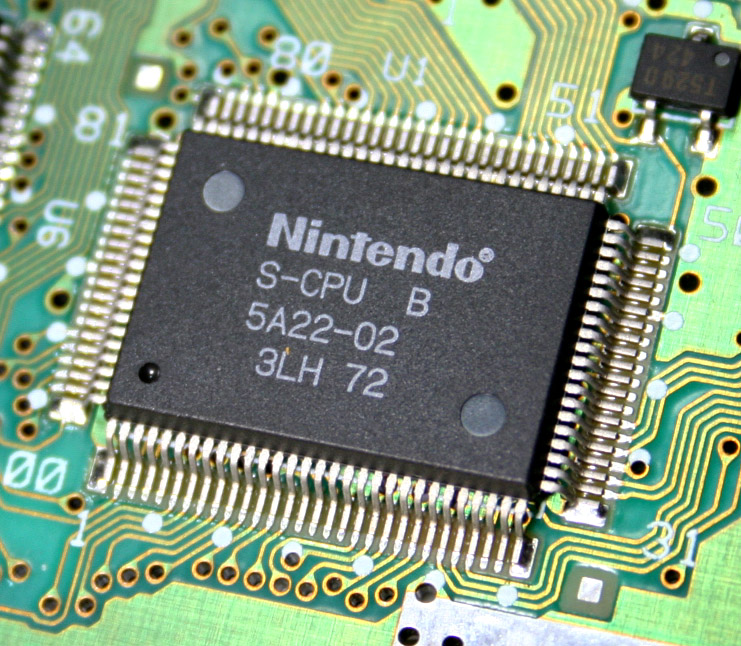
Ricoh 5A22
Custom CPU for the Super Nintendo Entertainment System
Ricoh manufactured this microprocessor for Nintendo's Super Nintendo Entertainment System. It adapts the WDC 65C816 core with extra hardware for graphics and input handling. The chip operates at variable speeds up to 3.58 MHz.
- Runs at variable speeds between 1.79 MHz and 3.58 MHz
- Based on the WDC 65C816 processor core
- Includes hardware for DMA and controller input
- Features a 24-bit address bus and 8-bit data bus
What it is
The Ricoh 5A22 serves as the central processing unit for the Super Nintendo Entertainment System. Ricoh produced this custom chip by modifying an existing design from the Western Design Center. It combines a standard processor core with specialized circuits for managing video signals and controller inputs. This integration allows the console to handle complex graphical tasks while maintaining compatibility with older software architectures.
How it came about
Engineers derived this processor from the WDC 65C816, a chip originally created for personal computers in the early 1980s. Ricoh adapted the design specifically for Nintendo's gaming hardware needs. The collaboration involved adding custom support logic to the base architecture. This approach allowed Nintendo to leverage proven technology while achieving the specific performance characteristics required for their new console generation.
Inside the chip
The core uses an extended instruction set from the MOS Technology 6502 family. It features a 16-bit accumulator and handles 92 distinct commands. Data moves across an 8-bit pathway, while memory addresses span 24 bits. The chip includes direct memory access units for fast data transfers during screen drawing. It also contains registers for mathematical operations and interfaces for reading game controllers.
How it was made
Ricoh fabricated the chip using proprietary methods not detailed in public records. The design integrates multiple functional blocks onto a single die. These include the main processor core, interrupt generators, and input/output ports. The manufacturing process focused on reliability for consumer electronics rather than pushing the limits of transistor density or speed.
Where it went
This processor powers every unit of the Super Nintendo Entertainment System. It manages game logic, processes player inputs, and coordinates with graphics chips. The variable clock speed helps balance performance with power consumption. Developers used its direct memory access features to update screen content efficiently without slowing down the main program execution.
Versions and family
The base design stems from the WDC 65C816 used in earlier computers. Nintendo later introduced the SA-1 co-processor, which shares the same underlying core architecture. No direct successor replaced the 5A22 within the SNES hardware line. The chip remains unique to this specific console generation and its peripheral devices.
Why it matters
It enabled the Super Nintendo to become a dominant force in the 16-bit era. The variable speed system allowed for efficient handling of different memory types. Its inclusion of hardware multiplication and division simplified game programming. The design demonstrated how customizing established cores could yield significant advantages for dedicated gaming hardware.
Questions people ask about Ricoh 5A22
What is the base architecture of the Ricoh 5A22?
It is built upon the WDC 65C816 core. This 8/16-bit design was originally developed for personal computers like the Apple IIGS before being adapted for gaming consoles.
How fast does the processor run?
The clock speed varies depending on the task. It reaches 3.58 MHz for most operations but drops to 1.79 MHz when accessing controller ports to ensure stable data reading.
Who designed and made this chip?
Western Design Center provided the original core design. Ricoh modified it and manufactured the final product specifically for Nintendo's Super Nintendo Entertainment System.
Good reading and sources
The facts on this page come from the Wikipedia article "Ricoh 5A22", written by its contributors and used under the CC BY-SA 4.0 licence, and from its Wikidata record (CC0). EveryChip rewrote the text in its own words, with AI assistance, and compares every page with the article to make sure no passage is copied. It may be reused under the same CC BY-SA 4.0 licence with a link back.
It may contain mistakes, and figures change over time. Nothing here is investment or buying advice. If something is wrong, tell us. Last refreshed 2026-11-14.
Like Ricoh 5A22
All CPUs and microprocessors 🇯🇵 JapanHuC6280
8-bit microprocessor for the TurboGrafx-16 consoleCPU · 8-bit
 🇺🇸 United StatesRCA 1802
8-bit CMOS microprocessor family from RCA, first of its kindCPU · 8-bit · 1974
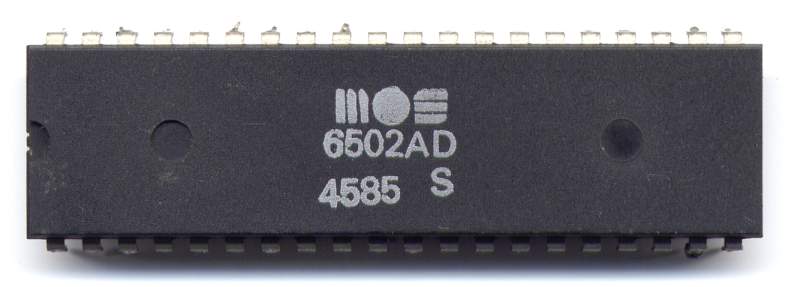 🇺🇸 United StatesMOS Technology 6502
An 8-bit microprocessor from 1975 that made cheap home computing possibleCPU · 8-bit · 1975
 🇺🇸 United StatesSignetics 2650
8-bit microprocessor from 1975 modelled on the IBM 1130 minicomputerCPU · 8-bit · 1975
More from Ricoh
All of them 🇯🇵 JapanHollywood
ATI system-on-a-chip for the Nintendo Wii consoleSoC · Arm
 🇺🇸 United StatesMOS Technology 6522
I/O controller chip for 6502 microprocessorsMicrocontroller · Other
🇺🇸 United StatesMOS Technology 6502
Low-cost 8-bit microprocessor that powered the home computer revolutionCPU · Other · 1975
 🇯🇵 JapanRicoh 2A03
8-bit CPU and sound chip for the Nintendo Entertainment SystemCPU · 68k · 1983