
GeForce 3 series
Third-generation Nvidia GPU with programmable shaders
Nvidia launched the GeForce 3 series in February 2001 as its third generation of graphics processors. It introduced programmable vertex and pixel shaders, marking a shift toward flexible rendering pipelines for real-time 3D graphics.
- First consumer GPU with programmable vertex and pixel shaders
- Manufactured by TSMC on a 150 nm process node
- Powered the graphics system in the original Microsoft Xbox
- Introduced multisample anti-aliasing for better efficiency
- Supported Microsoft Direct3D 8.0 and OpenGL 1.3
What it is
The GeForce 3 series represents the third generation of Nvidia graphics processing units. Released in early 2001, these chips brought programmable shading to consumer hardware. This allowed developers to write custom visual effects rather than relying on fixed functions. The architecture supported Microsoft Direct3D 8.0 and OpenGL 1.3. It included features like multisample anti-aliasing to smooth jagged edges efficiently. The series served both personal computers and the original Xbox console through a custom variant.
How it came about
Nvidia unveiled the chip at the Macworld Conference in Tokyo during February 2001. The launch occurred just three months after Nvidia acquired assets from rival 3dfx. Demonstrations included real-time renders of Pixar animations and early builds of Doom 3. Apple later secured rights to use the technology in its computer line. The family expanded in October 2001 with faster Ti models to compete with ATI releases. Support eventually ended, with final drivers for older Windows systems arriving in 2006.
Inside the chip
The Kelvin microarchitecture introduced the nFinite FX Engine. This unit enabled Vertex Shader 1.1 and Pixel Shader 1.1 execution. Four pixel pipelines could sample two textures per clock cycle. A Lightspeed Memory Architecture managed bandwidth by compressing depth buffers. Anti-aliasing improved via multisampling, which reduced performance costs compared to previous super-sampling methods. Anisotropic filtering increased to eight taps for sharper distant textures. The design retained some fixed-function hardware for legacy compatibility.
How it was made
TSMC manufactured all models using a 150 nanometre process. The original GeForce 3 and Ti500 shipped with 64 MiB of memory. The mid-range Ti200 offered options for 128 MiB configurations. Clock speeds varied across the lineup, ranging from 175 MHz on the entry model to 240 MHz on the high-end Ti500. The professional Quadro DCC variant adapted these features for computer-aided design workflows.
Where it went
These GPUs powered high-end personal computers for gaming and 3D applications. They enabled advanced lighting and shadow effects in compatible software. A derivative chip called NV2A served as the graphics processor for the Microsoft Xbox console. This version included an extra vertex shader to boost performance. The cards handled real-time demos and complex geometry processing for titles like Doom 3.
Versions and family
The family included the original GeForce 3, the Ti200, and the Ti500. The Ti500 offered higher core and memory clocks to match competing Radeon cards. The Ti200 provided a lower-cost entry point with reduced speeds. A professional Quadro DCC model targeted design professionals. The NV2A variant powered the Xbox console. Nvidia replaced the series with the GeForce 4 Ti in April 2002, which refined the same basic architecture.
Why it matters
This series established programmable shaders as a standard feature in consumer graphics. It moved the industry away from rigid fixed-function pipelines. The support for Direct3D 8.0 allowed developers greater creative control over visual styles. Multisample anti-aliasing became a common technique for improving image quality without severe performance penalties. The Xbox integration demonstrated the versatility of the underlying design for dedicated gaming hardware.
Problems and reception
Reviewers noted that raw throughput matched the previous GeForce 2 Ultra in some legacy tests. However, the new anti-aliasing methods offered clear advantages in modern scenarios. Some critics pointed out that competing ATI cards offered higher precision in shading operations. Production yields for the high-end Ti500 were poor, leading to its quick replacement. Naming confusion with the subsequent GeForce 4 MX line led to the early discontinuation of the Ti200.

Questions people ask about GeForce 3 series
What was the main innovation of the GeForce 3?
It introduced programmable vertex and pixel shaders, allowing developers to create custom visual effects instead of relying on fixed hardware functions. This marked a major shift in graphics processing flexibility.
Which console used a version of this chip?
The Microsoft Xbox used a derivative chip called NV2A. It was based on the GeForce 3 architecture but included an additional vertex shader for improved performance in console games.
How did it improve image quality?
It added multisample anti-aliasing and eight-tap anisotropic filtering. These techniques smoothed jagged edges and sharpened distant textures more efficiently than previous super-sampling methods.
Who manufactured the GeForce 3 series?
TSMC manufactured all models in the series using a 150 nanometre fabrication process. Nvidia designed the chips and marketed them under the GeForce brand.
Good reading and sources
- NVIDIA GeForceNvidia, Article
- Checking your browserAnandTech, Article
- PC Graphics Beyond XBOXTom's Hardware, Article
- GeForce 3 series on WikipediaEncyclopedia
- More photos on Wikimedia CommonsPhotos
- Wikidata recordOpen data
The facts on this page come from the Wikipedia article "GeForce 3 series", written by its contributors and used under the CC BY-SA 4.0 licence, and from its Wikidata record (CC0). EveryChip rewrote the text in its own words, with AI assistance, and compares every page with the article to make sure no passage is copied. It may be reused under the same CC BY-SA 4.0 licence with a link back.
It may contain mistakes, and figures change over time. Nothing here is investment or buying advice. If something is wrong, tell us. Last refreshed 2026-11-14.
Like GeForce 3 series
All graphics processors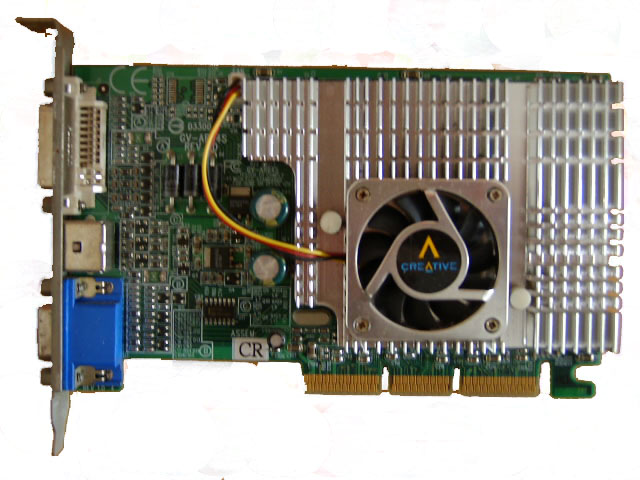 🇨🇦 CanadaRadeon R100
First generation Radeon graphics chip with hardware T&LGPU · GPU architecture · 2000
 WorldGeForce 4 series
Fourth generation of Nvidia GeForce graphics processorsGPU · GPU architecture · 2002
 WorldGeForce 256
Nvidia's first GeForce, a 1999 3D accelerator with hardware transform and lightingGPU · GPU architecture · 1999
 🇺🇸 United StatesGeForce
Nvidia brand of graphics processing units for PC gaming and computing.GPU · GPU architecture · 1999
More from Nvidia
All of them 🇯🇵 JapanSPARC64 V
Single-core SPARC V9 server microprocessor by FujitsuCPU · Other · 2001
WorldNForce
Nvidia motherboard chipset with integrated graphics and dual-channel memoryAnalog · 2001
 🇺🇸 United StatesKelvin
Nvidia GPU microarchitecture for GeForce 3 and 4 seriesGPU · GPU architecture · 2001
 WorldGeForce 2 series
Second-generation Nvidia graphics processors from 2000GPU · GPU architecture · 2000