
GeForce 256
Nvidia's first GeForce, a 1999 3D accelerator with hardware transform and lighting
The GeForce 256 is the graphics chip that opened Nvidia's GeForce line, announced in August 1999 and shipped that October. Built by TSMC on a 220 nm CMOS process, it moved geometry work off the CPU and was the first accelerator to fully meet Direct3D 7.
- First product in Nvidia's GeForce line, released 11 October 1999
- First accelerator with full Direct3D 7 compliance
- Four 64-bit pixel pipelines, marketed as a 256-bit QuadPipe engine
- Built by TSMC on a 220 nm CMOS process
- Same silicon later sold for CAD as Quadro
What it is
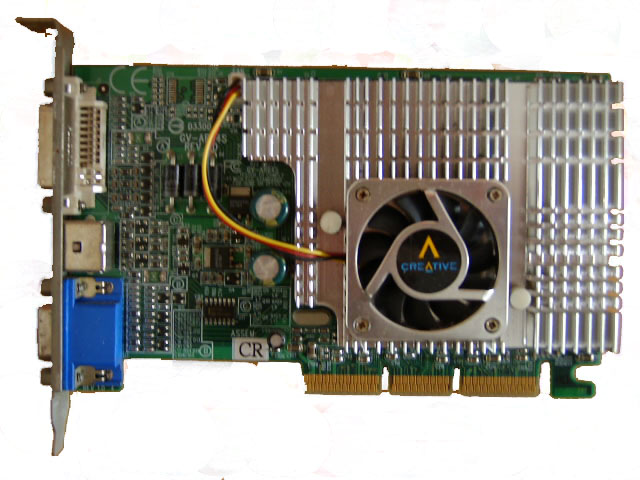
GeForce 256 was the first product in Nvidia's GeForce family and a 3D accelerator for PCs. It arrived in October 1999, with a DDR memory version following in December. Compared with the RIVA TNT2 before it, the chip carried more fixed pixel pipelines, handled transform and lighting work in hardware rather than leaving it to the host processor, and included MPEG-2 motion compensation. Nvidia promoted it as the first GPU, a name it defined around a single piece of silicon doing geometry setup, clipping and rendering. It was also the first accelerator to implement Direct3D 7 in full.
How it came about
Nvidia announced the part on 31 August 1999 and shipped it on 11 October. The design goal was to relieve the CPU of geometry maths, a job previously done in software. That shift lowered the cost of 3D hardware enough for ordinary consumer cards, where earlier accelerators had been aimed at expensive computer-aided design work. The same silicon also let Nvidia enter that CAD market under the Quadro name, using GeForce chips with different drivers and certification. Only one GeForce 256 chip was released; later GeForce generations varied speeds and prices instead.
Inside the chip
The NV10 die carries four 64-bit pixel pipelines, marketed as a 256-bit QuadPipe rendering engine. With one texture unit per pipeline, it can draw four pixels per clock in single-texture scenes but only two when two textures are combined, matching the TNT2 arrangement. New rendering features include cube environment mapping and dot-product bump mapping. A hardware transform and lighting engine takes over geometry work from the processor, and a motion compensation unit handles MPEG-2 video. The chip supports OpenGL 1.2.1 with transform and lighting, plus Direct3D 7.0.
How it was made
TSMC fabricated the GeForce 256 on its 220 nm CMOS process. Two memory builds were sold: an SDR board from October 1999 using Samsung Electronics memory, and a DDR board from mid-December 1999 using Hyundai Electronics memory, a company now called SK Hynix. Nvidia has since ended driver support for the series.
Where it went
The chip went into consumer graphics cards for 3D PC gaming. Against rivals such as the 3dfx Voodoo3 3500 and Nvidia's own RIVA TNT2 Ultra, it could raise frame rates by half or more in games written for its transform and lighting hardware, especially alongside a cheap processor. Because GeForce 2 MX and GeForce 4 MX cards kept a similar feature set, games supported the GeForce 256 until roughly 2006, including Star Wars: Empire at War and Half-Life 2.
Versions and family
There was a single GeForce 256 chip, sold in two memory configurations. The SDR model arrived first, in October 1999, and the DDR model followed in mid-December. The RIVA TNT2 came before it, and the GeForce 2 series replaced it. Quadro cards used the same silicon with drivers and certification aimed at CAD software. Nvidia's later HDVP video unit in the GeForce 2 GTS succeeded the first-generation motion compensation block.
Why it matters
GeForce 256 gave the GeForce brand its start and helped popularise the term GPU. Moving transform and lighting onto the card made capable 3D hardware affordable for ordinary PCs rather than specialist workstations, and it opened a CAD product line for Nvidia. Long driver support followed because later mainstream cards shared its capabilities.
Problems and reception
Reviewers noted that few programs used hardware transform and lighting at first, so the benefit showed mainly in certain OpenGL shooters such as Quake III Arena. With a cheap Celeron 300A the card looked strong, yet a fast Pentium II 300 could let older boards such as the 3dfx Voodoo 2 pull ahead. Rivals argued a quick CPU covered the gap. Early drivers were slow and unreliable, and 3dfx still held mature Glide and MiniGL support. The card was also costly, with little advantage outside 3D work.


Questions people ask about GeForce 256
What does the number 256 refer to?
It comes from Nvidia's name for the rendering engine: four pixel pipelines, each 64 bits wide, giving a 256-bit path. The chip can output four pixels per clock with one texture, or two per clock when two textures are combined on the same pixel.
What was new about its transform and lighting unit?
Earlier accelerators left geometry maths to the PC's processor. GeForce 256 did that work on the card itself, which reduced the load on the CPU and helped cheaper machines run 3D games well. Software written to use it could gain a large speed-up.
Which memory versions were sold?
Two. An SDR board launched in October 1999 with Samsung memory, and a DDR board arrived in mid-December 1999 with memory from Hyundai Electronics, now SK Hynix. The chip itself was the same in both.
Is it still supported?
No. Nvidia ended driver support for the GeForce 256 series. The last Windows 9x and Me driver was version 71.84 from March 2005, and the last Windows 2000 and XP driver was 71.89 from April 2005.
Good reading and sources
- NVIDIA RTX and Quadro Workstations for Data ScienceNvidia, Article
- Checking your browserAnandTech, Article
- High-Tech And Vertex JugglingTom's Hardware, Article
The facts on this page come from the Wikipedia article "GeForce 256", written by its contributors and used under the CC BY-SA 4.0 licence, and from its Wikidata record (CC0). EveryChip rewrote the text in its own words, with AI assistance, and compares every page with the article to make sure no passage is copied. It may be reused under the same CC BY-SA 4.0 licence with a link back.
It may contain mistakes, and figures change over time. Nothing here is investment or buying advice. If something is wrong, tell us. Last refreshed 2026-11-14.
Like GeForce 256
All graphics processors 🇺🇸 United StatesGeForce
Nvidia brand of graphics processing units for PC gaming and computing.GPU · GPU architecture · 1999
 🇺🇸 United StatesRIVA TNT
Nvidia dual-texel graphics accelerator for PCsGPU · GPU architecture · 1998
 🇨🇦 CanadaRadeon R100
First generation Radeon graphics chip with hardware T&LGPU · GPU architecture · 2000
 🇺🇸 United StatesRIVA TNT
Dual-pipeline PC graphics chip from NvidiaGPU · GPU architecture · 1998
More from Nvidia
All of them 🇺🇸 United StatesRIVA TNT2
Nvidia graphics chip from 1999 with dual pipelinesGPU · GPU architecture · 1999
🇺🇸 United StatesCelsius
Nvidia GPU microarchitecture from 1999GPU · GPU architecture · 1999
 WorldRise mP6
Low-cost x86 microprocessor for Super Socket 7 systemsCPU · x86 · 1998
 🇺🇸 United StatesTransmeta Crusoe
Low-power x86 microprocessor using software translationCPU · x86 · 2000