Memory chips
The Intel 1103, DRAM, SRAM, NAND and NOR flash, HBM and 3D XPoint. 56 chips on EveryChip so far.
Memory chips store the bits that processors work on. DRAM holds a computer's working memory and forgets it when power goes off. SRAM is faster and is used for caches inside processors. Flash keeps data without power, in phones, memory cards and solid-state drives. High Bandwidth Memory (HBM) stacks DRAM dies beside AI chips. Memory is made in vast volumes by a few firms: Samsung, SK hynix, Micron, Kioxia and others.
How the main types work
A DRAM cell is one transistor and one tiny capacitor that holds a charge for a 1 or no charge for a 0; the charge leaks, so it must be refreshed thousands of times a second. An SRAM cell uses six transistors that hold their state while powered. A flash cell traps charge in an insulated layer, so it keeps its value for years. 3D NAND flash stacks cells in more than 200 layers.
From the 1103 to HBM
Intel's 1103, released in 1970, held 1 kilobit and was the first DRAM chip sold widely; it replaced magnetic core memory within a few years. Toshiba invented flash in the 1980s. DRAM capacity has grown to tens of gigabits per die. HBM, standardised in 2013, stacks up to 12 or more DRAM dies linked by vertical wires and is now the costliest and most sought-after memory, because of AI.
Famous memory chips
 Intel 1103First widely sold DRAM chip, 1970
 High Bandwidth MemoryStacked DRAM beside AI accelerators
 DDR5 SDRAMMain memory of PCs and servers from 2021
 GDDR6 SDRAMGraphics memory of GPUs and consolesHybrid Memory CubeMicron's stacked DRAM of the 2010s
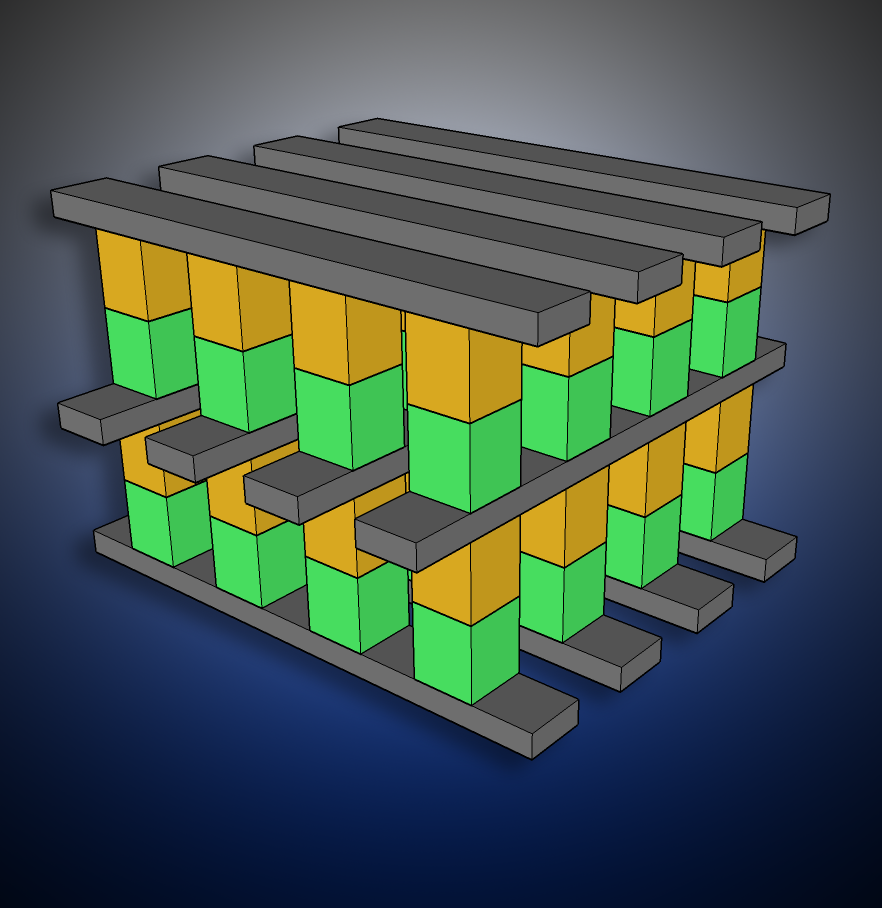 3D XPointIntel and Micron's memory between DRAM and flash
Further reading
 World6264
JEDEC-standard 64 Kbit static RAM chipMemory
 🇺🇸 United StatesIBM 2361
Magnetic core memory expansion for IBM System/360 mainframesMemory
🇺🇸 United StatesHyperCloud Memory
High-density DDR3 server memory module by NetlistMemory · 2009
🇯🇵 JapanFast Cycle DRAM
Low-latency synchronous DRAM by Fujitsu and ToshibaMemory
WorldRLDRAM
Low-latency dynamic memory for networking and embedded systemsMemory · 1999
 WorldPC66
Standard for 66 MHz synchronous memory modulesMemory
 🇯🇵 JapanPLEDM
A volatile semiconductor memory chip developed by Hitachi in 1999.Memory · 1999
Photo credits on this page
The small pictures above come from Wikimedia Commons under free licences. Some are cropped to fit.
- DDR5 SDRAM: Jacek Halicki, CC BY-SA 4.0, source
- PC133: Vitaly Zdanevich, CC0, source
- 3D XPoint: Trolomite, CC BY-SA 4.0, source
- GeForce RTX 30 series: PantheraLeo1359531, CC BY 4.0, source
- Intel 1103: Thomas Nguyen, CC BY-SA 4.0, source
- High Bandwidth Memory: Fritzchens Fritz, CC0, source
- 6264: Raimond Spekking, CC BY-SA 4.0, source
- IBM 2361: Bubba73 , Jud McCranie, CC BY-SA 4.0, source
- PLEDM: ElooKoN, CC BY-SA 4.0, source