
Pentium OverDrive
Intel's mid-1990s upgrade chips for 486 and Pentium motherboards
Pentium OverDrive was Intel's brand for consumer upgrade microprocessors sold in the mid-1990s. The first models put a modified 3.3 V Pentium P54 core into 486 sockets, and later versions served Socket 4, Socket 5 and Socket 8 systems, including the Pentium II OverDrive used in the ASCI Red supercomputer.
- 32 kB L1 cache, double the 16 kB of a standard P54C chip
- 63 MHz model launched 3 February 1995; 83 MHz part followed in September
- Fan failure made the chip throttle its clock to avoid overheating
- Pentium II OverDrive ran at 300 or 333 MHz with 512 kB full-speed L2 cache
- All 4,510 ASCI Red nodes were upgraded to these chips in 1999
What it is
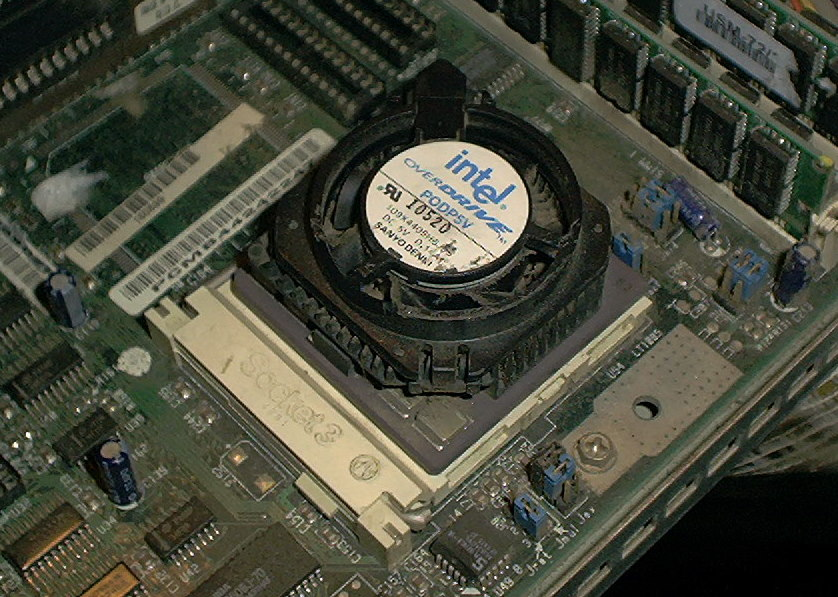
Pentium OverDrive was the name Intel gave to a set of upgrade microprocessors aimed at consumers in the middle of the 1990s. The earliest parts were built for 486 motherboards, and later ones fitted certain Pentium sockets plus a version for Socket 8. The 486 models used a heavily reworked 3.3 volt Pentium P54 core made on 0.6 micrometer technology, with a 486-style bus unit, a fixed heatsink and fan, and 32 kB of level 1 cache. Because the data bus was cut to 32 bits, each clock cycle did less work than a standard Pentium, but the chip still beat a 486 at the same speed.
How it came about
Intel released the 63 MHz part on 3 February 1995 for 25 MHz bus systems. A faster 83 MHz version followed in September of that year, handling 25 and 33 MHz buses, and it cost $299, far more than rival upgrade chips from AMD and Cyrix. A specification change during development caused trouble on some boards, so the Packard Bell 450 needed a special interposer between chip and motherboard, which blocked access to the board's level 2 cache. In 1998 the line continued with a Socket 8 upgrade for Pentium Pro owners.
Inside the chip
The 486 parts carried 32 kB of level 1 cache, split 16 kB plus 16 kB, twice what a normal P54C offered. A 486-compatible bus unit sat on the package, and an on-chip 3.3 volt regulator let the part run in boards that only supplied 5 volts. The heatsink was fixed and the fan clipped on, drawing power through springy metal prongs touching three conductors on the chip surface. The processor watched the fan and slowed its clock if it stopped, guarding against overheating. The Pentium II OverDrive paired a Deschutes core with 512 kB of full-speed level 2 cache.
How it was made
The 486-based models were built on 0.6 micrometer technology at 3.3 volts. The Socket 8 Pentium II OverDrive used a 0.25 micrometre Deschutes core in a flip-chip package, combined with a 512 kB full-speed level 2 cache die taken from the Pentium II Xeon and mounted on a Socket 8 module. The 486 parts came in a 234-pin P24T package.
Where it went
The chips went into older desktop machines that owners wanted to speed up without replacing the motherboard. Most Socket 3 boards, especially later VLB and PCI designs, ran them properly with full level 2 cache access. The Socket 8 Pentium II OverDrive served single and dual processor systems, and worked unofficially in larger ALR 6x6 machines. Notably, Intel's ASCI Red supercomputer at Sandia National Laboratories was upgraded to dual Pentium II OverDrive chips across all 4,510 of its computing nodes in 1999.
Versions and family
The 486 family comprised PODP5V63 at 63 MHz on a 25 MHz bus and PODP5V83 at 83 MHz on a 33 MHz bus. Socket 4 parts ran at 120 or 133 MHz, while Socket 5 models reached 125, 150 and 166 MHz. Pentium OverDrive MMX then replaced these, adding MMX support for Pentium 120 to 200 MHz systems. The Socket 8 PODP66X333 ran at 300 or 333 MHz.
Why it matters
ASCI Red, already the first machine past one teraFLOPS and the world's fastest computer from 1997 until late 2000, kept its lead for a time after the 1999 upgrade and became the first system above two teraFLOPS. It ran these processors until being decommissioned in 2006. The design also foreshadowed on-die full-speed cache in later Intel mobile and Pentium III cores.
Problems and reception
Synthetic benchmarks of the day often placed the chip below cheaper, faster-clocked rivals. Real results differed when the motherboard cache was used well, since floating-point heavy code and software written for Pentium gained more. Compatibility was uneven: some older chipsets could not use the write-back mode of the level 1 cache, and boards affected by the specification change ran below par.


Questions people ask about Pentium OverDrive
What was the Pentium OverDrive for?
It was an upgrade product line Intel sold in the mid-1990s so owners of older machines could gain speed without a new motherboard. Early models fitted 486 sockets, later ones certain Pentium sockets, and a final version targeted Socket 8 systems built around the Pentium Pro.
How did it differ from a normal Pentium?
The 486 versions used a modified 3.3 volt P54 core with a 486-style bus, so the data path was only 32 bits wide and each clock did less than a standard Pentium. In return they doubled level 1 cache to 32 kB and added an on-chip regulator for 5 volt boards.
Did it run Pentium software?
Yes. It supported programs and operating systems written specifically for the Pentium architecture, including emulators, multimedia tools and later Windows releases and games, though the older bus and clock speeds limited the gain.
Where did the Socket 8 version end up?
The Pentium II OverDrive, running at 300 or 333 MHz, was installed across all 4,510 computing nodes of Intel's ASCI Red supercomputer at Sandia National Laboratories in 1999, and stayed in service there until the machine was decommissioned in 2006.
What cooling did the chip use?
A heatsink was permanently attached and a removable fan clipped on, powered through spring-like metal prongs meeting three conductors on the chip. If the fan stopped, the processor reduced its own clock speed to prevent heat damage.
Good reading and sources
- Pentium OverDrive on WikipediaEncyclopedia
- More photos on Wikimedia CommonsPhotos
- Wikidata recordOpen data
The facts on this page come from the Wikipedia article "Pentium OverDrive", written by its contributors and used under the CC BY-SA 4.0 licence, and from its Wikidata record (CC0). EveryChip rewrote the text in its own words, with AI assistance, and compares every page with the article to make sure no passage is copied. It may be reused under the same CC BY-SA 4.0 licence with a link back.
It may contain mistakes, and figures change over time. Nothing here is investment or buying advice. If something is wrong, tell us. Last refreshed 2026-11-14.
Like Pentium OverDrive
All CPUs and microprocessors 🇺🇸 United StatesPentium Pro
Intel's first sixth-generation x86 CPU, built for servers and workstationsCPU · x86 · 1995
 🇺🇸 United StatesCascade Lake
Intel 14 nm server and workstation processor generationCPU · x86 · 2019
 🇺🇸 United StatesSapphire Rapids
Intel server and workstation chips with chiplet designCPU · x86 · 2023
 🇺🇸 United StatesP6
Intel's sixth x86 design, first with out-of-order executionCPU · x86 · 1995
More from Intel
All of them 🇺🇸 United StatesPIIX
Intel southbridge family for x86 PCs from the mid-1990sAnalog · x86 · 1995
🇺🇸 United StatesStrongARM
High-performance ARM microprocessor family for portable devicesCPU · Arm · 1996
 🇺🇸 United StatesIntelDX4
Clock-tripled i486 CPU with 16 KB cache, at 75 or 100 MHzCPU · x86 · 1994
 WorldIntel 80386EX
Embedded variant of the 386 with on-chip peripherals, launched in 1994CPU · x86 · 1994