Cyclops64
IBM cellular architecture aiming for a supercomputer on a single chip.
Cyclops64 is a processor architecture developed by IBM as part of the Blue Gene supercomputing programme. It integrates eighty processors onto one chip to achieve high parallel performance, targeting scientific simulations and complex calculations through a unique cellular design.
- Integrates 80 processors on a single chip
- Runs at 500 MHz with 64-bit RISC cores
- Part of IBM's Blue Gene supercomputing effort
- Theoretical peak of 80 gigaflops per chip
- Uses a 96-port crossbar switch for connectivity
What it is
Cyclops64, previously called Blue Gene/C, is a processor design created by IBM. It represents an attempt to build a supercomputer on a single integrated circuit. The project falls under the broader Blue Gene initiative, which seeks to advance high-performance computing capabilities. This architecture uses a cellular approach, packing many small processing units together to handle massive amounts of data simultaneously. It was developed in response to competing supercomputing projects like the Earth Simulator.
How it came about
The project emerged from the Blue Gene effort to create next-generation supercomputers. IBM led the development, with support from the United States Department of Energy and the Department of Defense. Academic institutions also contributed to the cooperative venture. Monty Denneau, a recipient of the Seymour Cray Award, conceived the architecture and leads the team. The goal was to surpass existing systems by integrating extreme parallelism directly onto silicon.
Inside the chip
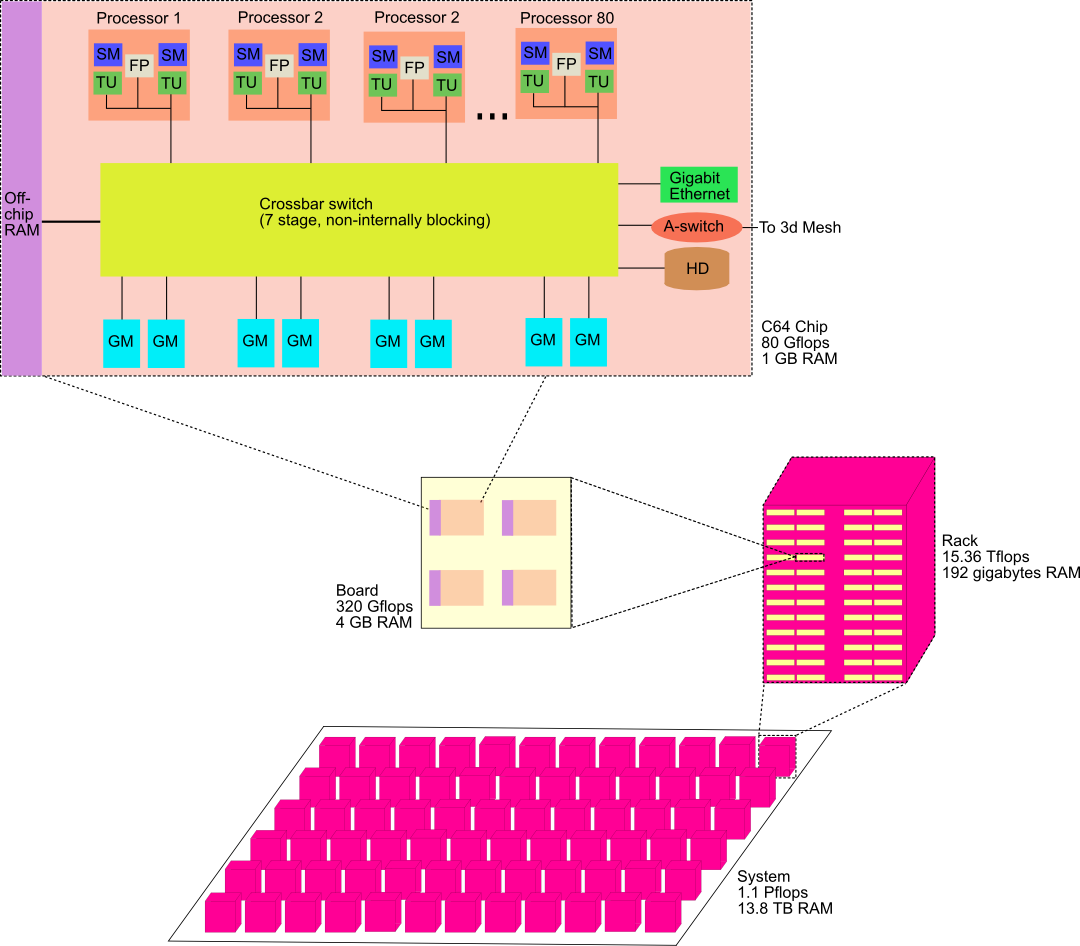
Each chip contains eighty individual 64-bit processors running at 500 megahertz. Every processor includes two thread units and a floating-point unit. These thread units are in-order RISC cores that use a subset of the Power ISA instruction set. Each core has 32 kilobytes of scratch pad memory. Five processors share a 32 kilobyte instruction cache. A non-blocking crossbar switch connects the processors, allowing them to communicate via global interleaved SRAM. This design enables over a million concurrent threads in a full system.
How it was made
Specific details regarding the manufacturing process node, transistor count, or physical packaging are not provided in the available records. The focus of the public documentation remains on the logical architecture and system integration rather than the semiconductor fabrication specifics. Verification testing and software development tasks were carried out at the University of Delaware.
Where it went
The architecture targets high-performance computing environments. A complete system would consist of thousands of chips arranged in racks. This setup allows for massive parallel processing suitable for scientific simulations and complex mathematical modelling. The theoretical peak performance of a single chip is 80 gigaflops, assuming continuous multiply-accumulate operations. Full systems aim to leverage this density for large-scale computational tasks.
Versions and family
Cyclops64 was formerly known as Blue Gene/C. It is part of the wider Blue Gene family of supercomputers. No specific commercial variants or successor chips are detailed in the current information. The project remains described as being in development, with no released consumer or enterprise products listed.
Why it matters
The project aimed to redefine supercomputing by placing an entire system's logic on one chip. It influenced discussions on parallel processing and cellular architectures. By exposing hardware details to programmers, it sought to enable highly tuned software, though this increased programming complexity. The collaboration between government, industry, and academia highlighted a model for large-scale technical development.
Problems and reception
Programming the Cyclops64 is noted as difficult due to the exposure of underlying hardware details. While this allows for high-performance tuning, it requires significant expertise. The system supports TiNy-Threads and POSIX Threads to help manage concurrency. No specific bugs, recalls, or market reception data are available as the project is described as being in development.
Questions people ask about Cyclops64
What is the Cyclops64?
Cyclops64 is a processor architecture developed by IBM, formerly known as Blue Gene/C. It aims to create a supercomputer on a single chip by integrating eighty processors into one unit for high-performance computing tasks.
How many processors are on one Cyclops64 chip?
Each Cyclops64 chip contains 80 individual processors. Each of these processors has two thread units and a floating-point unit, allowing for massive parallel processing within a single integrated circuit.
Who developed the Cyclops64 architecture?
IBM developed the Cyclops64 architecture as part of its Blue Gene project. The effort was supported by the US Department of Energy, the Department of Defense, and academic partners, with Monty Denneau leading the design.
What instruction set does Cyclops64 use?
The processors use a 60-instruction subset of the Power ISA instruction set. Each thread unit acts as an in-order 64-bit RISC core, designed for efficient execution of specific computational tasks.
Good reading and sources
The facts on this page come from the Wikipedia article "Cyclops64", written by its contributors and used under the CC BY-SA 4.0 licence, and from its Wikidata record (CC0). EveryChip rewrote the text in its own words, with AI assistance, and compares every page with the article to make sure no passage is copied. It may be reused under the same CC BY-SA 4.0 licence with a link back.
It may contain mistakes, and figures change over time. Nothing here is investment or buying advice. If something is wrong, tell us. Last refreshed 2026-11-14.
Like Cyclops64
All CPUs and microprocessors 🇺🇸 United StatesIBM Power
RISC microprocessors for servers and supercomputers by IBMCPU · Power · 1990
 🇺🇸 United StatesPOWER2
IBM RISC processor for RS/6000 workstationsCPU · Power · 1993
 🇺🇸 United StatesPowerPC 400
Embedded 32-bit RISC processor cores for diverse applicationsCPU · Power · 1994
 🇺🇸 United StatesPOWER3
64-bit PowerPC microprocessor for IBM workstations and serversCPU · Power · 1998
More from IBM
All of them WorldDRAM
Volatile semiconductor memory using capacitors and transistors for high-density storage.Memory
🇺🇸 United StatesTelum II
Mainframe processor for IBM z17 with AI accelerationCPU · Other
🇺🇸 United StatesNorthPole
Brain-inspired AI inference chip by IBM ResearchAI accelerator · Other