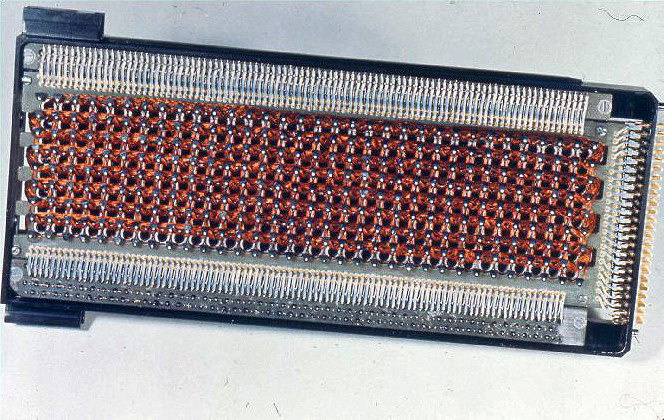
Core rope memory
Read-only memory woven from magnetic cores and wire
Core rope memory is a form of read-only storage used in early computers like the UNIVAC I and the Apollo Guidance Computer. Data was physically encoded by threading wires through or around magnetic cores, creating a durable and dense medium for software.
- Data is stored by weaving wires through magnetic cores
- Used in the Apollo Guidance Computer for moon missions
- Nicknamed LOL memory for Little Old Lady memory
- Invented by T. L. Dimond at Bell Laboratories in the 1940s
- Stored 72 kilobytes per cubic foot of volume
What it is
Core rope memory is a type of read-only memory that stores data through the physical arrangement of wires and magnetic rings. Unlike modern chips, the software is literally woven into the hardware. It was prominent in the 1950s and 1960s for systems requiring reliable, unchangeable code, such as the UNIVAC mainframes and NASA space probes. The technology allowed for high density relative to its contemporaries, packing significant data into small volumes.
How it came about
The concept originated in the early 1940s at Bell Laboratories, invented by T. L. Dimond. It was initially called the Diamond ring translator and served in electromechanical telephone switches to record billing information. In the 1950s, it became popular for computer program storage in machines like the UNIVAC I and II. Later, during the 1960s space race, it was adopted for the Apollo Guidance Computer, where MIT programmers designed the software and factory workers wove it into the memory modules.
Inside the chip
The system uses magnetic cores, but unlike core memory, the cores do not hold the state. Instead, the wiring pattern defines the data. Sense wires pass through a core to represent a binary one or bypass it for a zero. To read data, a current changes the polarity of all cores. Inhibit wires prevent unwanted cores from flipping, isolating the specific address. This method allowed each core in the Apollo computer to store twelve 16-bit words via 192 sense wires.
How it was made
Manufacturing involved manual labor, often performed by women in factories who threaded wires through the magnetic rings according to software diagrams. This process earned it the nickname LOL memory, standing for Little Old Lady memory. The physical weaving made the memory extremely robust and resistant to radiation, which was critical for space missions. Raytheon built the units for the Apollo programme based on designs from the MIT Instrumentation Lab.
Where it went
This memory type powered the UNIVAC I and UNIVAC II commercial computers in the 1950s. Its most famous application was in the Apollo Guidance Computer, which navigated astronauts to the Moon. It also appeared in early NASA Mars probes. The technology was chosen for these missions because the stored program could not be accidentally altered, ensuring mission-critical code remained intact during flight.
Why it matters
Core rope memory offered about 18 times the density of standard magnetic-core memory of the era. It provided roughly 72 kilobytes per cubic foot, or 2.5 megabytes per cubic meter. This efficiency allowed complex guidance software to fit within the strict weight and size limits of spacecraft. It demonstrated that physical manufacturing processes could effectively serve as software distribution media.


Questions people ask about Core rope memory
How does core rope memory store data?
It stores data physically by threading sense wires through or around magnetic cores. A wire passing through a core represents a binary one, while bypassing it represents a zero. The pattern of wires encodes the software permanently.
Why was it called LOL memory?
Programmers nicknamed it LOL memory, meaning Little Old Lady memory. This referred to the female factory workers who manually wove the wires through the magnetic cores to create the memory modules.
What computers used core rope memory?
It was used in the UNIVAC I and UNIVAC II mainframes in the 1950s. Later, it powered the Apollo Guidance Computer for NASA moon missions and early Mars space probes in the 1960s.
Good reading and sources
- Core rope memory on WikipediaEncyclopedia
- More photos on Wikimedia CommonsPhotos
- Wikidata recordOpen data
The facts on this page come from the Wikipedia article "Core rope memory", written by its contributors and used under the CC BY-SA 4.0 licence, and from its Wikidata record (CC0). EveryChip rewrote the text in its own words, with AI assistance, and compares every page with the article to make sure no passage is copied. It may be reused under the same CC BY-SA 4.0 licence with a link back.
It may contain mistakes, and figures change over time. Nothing here is investment or buying advice. If something is wrong, tell us. Last refreshed 2026-11-14.
Like Core rope memory
All memory chips WorldNvSRAM
Fast static memory with built-in non-volatile storage for data retention.Memory
 WorldDataFlash
Serial interface flash memory with SPI compatibilityMemory
 WorldFerroelectric RAM
Non-volatile memory using ferroelectric capacitors for fast writes and low power.Memory
