Other and custom
Transputers, Lisp machines, Soviet and Chinese designs and one-off architectures. 262 chips on EveryChip so far.
Not every processor fits a big family. This group holds one-off and national designs: the British transputer built for parallel computing, Intel's ambitious iAPX 432, machines built to run the Lisp language, the Linn Rekursiv, and the Chinese ShenWei chips of the Sunway supercomputers. Some failed commercially but left ideas that later designs reused.
Ambitious experiments
Intel's iAPX 432 of 1981 tried to build object protection and garbage collection into hardware; it was slow and was dropped, while the stopgap 8086 succeeded. Inmos's transputer put serial links on every chip so that processors could be wired into networks. The Rekursiv, designed for the hi-fi maker Linn in the late 1980s, ran object-oriented programs in microcode.
National designs
Countries cut off from Western chips have built their own. The Soviet Union cloned and extended Western designs. China's ShenWei SW26010, with 260 cores, powered the Sunway TaihuLight, the world's fastest supercomputer from June 2016 to June 2018, made entirely with Chinese-designed processors. Loongson's LoongArch, introduced in 2021, is another home-grown instruction set.
Famous other chips


Further reading
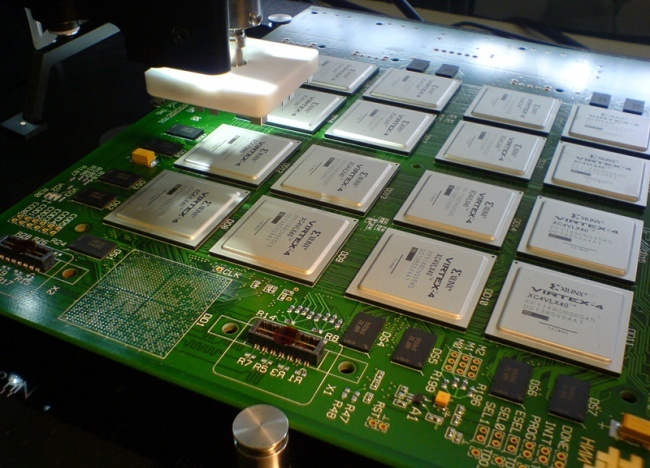
Photo credits on this page
The small pictures above come from Wikimedia Commons under free licences. Some are cropped to fit.
- Transputer: NobbiP, CC BY-SA 3.0, source
- Intel iAPX 432: _brouhaha_, CC BY-SA 2.0, source
- Virtex: Антракт, CC BY-SA 4.0, source