Motorola 68000 family
The 68000 of the first Macintosh, Amiga, Atari ST and Mega Drive. 25 chips on EveryChip so far.
The Motorola 68000 family began with the 68000 of 1979, a chip with 32-bit registers inside and a 16-bit data bus outside. Its clean, programmer-friendly design made it the processor of the first Apple Macintosh (1984), the Commodore Amiga and Atari ST (1985), early Sun workstations, many arcade boards and the Sega Mega Drive. Successors ran to the 68060 of 1994.
Why programmers liked it
The 68000 had sixteen 32-bit registers and a regular set of instructions and addressing modes, which made it easy to program in assembly language and to write compilers for. It was designed by Motorola in Austin, Texas. Its name is often linked to its count of about 68,000 transistor sites.
The family and its end
The 68020 of 1984 went fully 32-bit, the 68030 added memory management on chip, and the 68040 of 1990 added a floating-point unit. Apple, Commodore and Atari moved on in the 1990s, Apple to PowerPC. Cut-down 68k cores lived on for years in embedded controllers and Palm handhelds, and Motorola's later ColdFire line continued the instruction set in simpler form.
Famous 68k chips


Further reading
 🇺🇸 United States68HC12
16-bit microcontroller family from Motorola and FreescaleMicrocontroller · 68k · 1995
 🇳🇱 NetherlandsPhilips 68070
16/32-bit microcontroller based on the Motorola 68000 coreMicrocontroller · 68k · 1985
 🇺🇸 United StatesColdFire
Embedded microprocessor family derived from the Motorola 68000 architecture.Microcontroller · 68k · 1994
 🇺🇸 United StatesMotorola 68HC11
8-bit microcontroller family for embedded systemsMicrocontroller · 68k · 1984
🇺🇸 United StatesMotorola 68HC16
A 16-bit microcontroller family designed as an upgrade path for 8-bit systems.Microcontroller · 68k
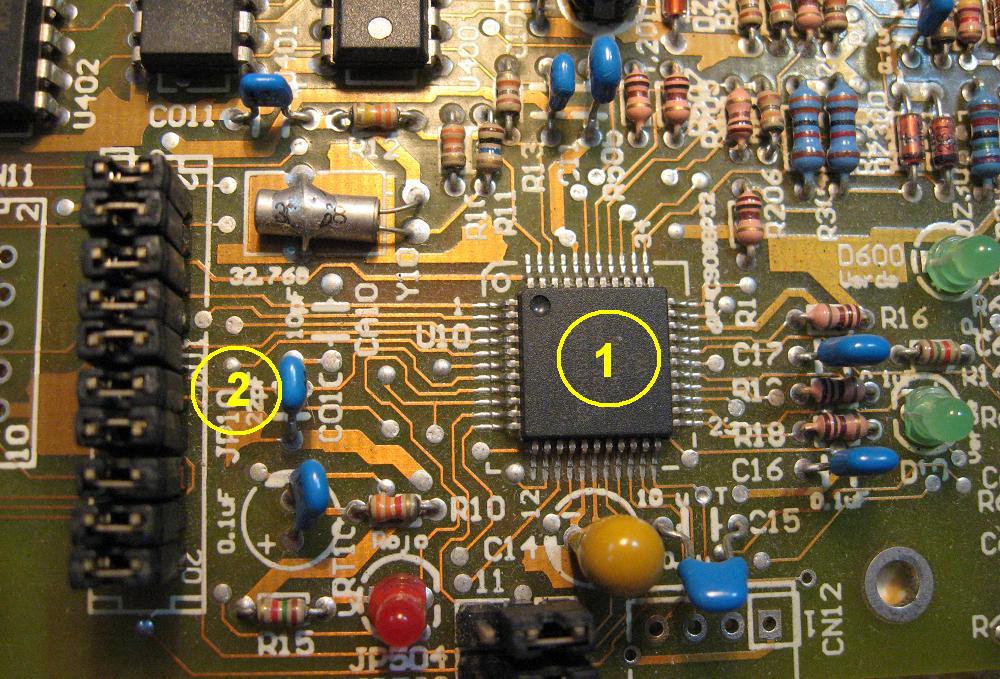 World68HC08
An 8-bit microcontroller series from Motorola and Freescale.Microcontroller · 68k
 🇺🇸 United StatesDragonBall
Low-power microcontroller for early handheld computersMicrocontroller · 68k · 1995
 🇺🇸 United StatesFreescale 683xx
Modular microcontroller family based on the Motorola 68000 core.Microcontroller · 68k · 1993
WorldQUICC
Motorola 68k-based microcontroller for telecomsMicrocontroller · 68k
🇺🇸 United StatesMC68340
32-bit microprocessor with integrated DMA and system functionsMicrocontroller · 68k
🇺🇸 United StatesHandy Board
Open-source handheld robotics controller based on 68HC11 microcontrollerMicrocontroller · 68k
Photo credits on this page
The small pictures above come from Wikimedia Commons under free licences. Some are cropped to fit.
- 68HC12: Sumanch, CC BY-SA 3.0, source
- Motorola 68040: Konstantin Lanzet, CC BY-SA 3.0, source
- Motorola 68HC11: Konstantin Lanzet, CC BY 3.0, source
- 68HC08: Cmarcante, CC BY-SA 3.0, source
- DragonBall: Raimond Spekking, CC BY-SA 4.0, source
- Freescale 683xx: Pauli Rautakorpi, CC BY 3.0, source
- Philips 68070: Wosch21149, CC BY-SA 3.0, source
- ColdFire: Raimond Spekking, CC BY-SA 4.0, source
- Motorola 68030: Unknown author, CC BY-SA 3.0, source
- Motorola 68020: David Monniaux, CC BY-SA 3.0, source
- Motorola 68060: Konstantin Lanzet (with permission), CC BY-SA 3.0, source
- Motorola 68012: Pauli Rautakorpi, CC BY 3.0, source