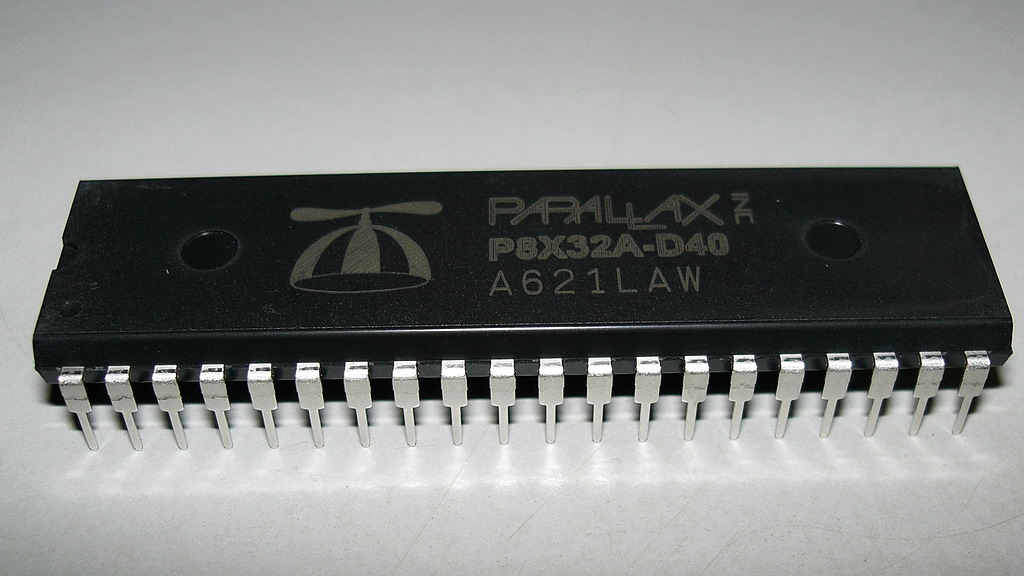
Parallax Propeller
Eight-core microcontroller with parallel processing
The Parallax Propeller is an eight-core microcontroller released in 2006 by Parallax Inc. It uses parallel processing cores called cogs to handle tasks without traditional interrupts. The chip supports video generation and real-time control through dedicated hardware.
- Features eight independent 32-bit processor cores
- Generates video signals using software and hardware timers
- Released as open-source hardware in 2014
- Runs at speeds up to 80 MHz with dynamic clock control
- Uses dedicated cores to handle inputs without interrupts
What it is
The Parallax Propeller is a microcontroller chip featuring eight independent 32-bit processor cores. Introduced in 2006 by Parallax Inc., it differs from standard single-core designs by running multiple tasks in parallel. Each core, known as a cog, operates simultaneously to manage input, output, and computation. This architecture allows the chip to generate video signals and handle real-time events without complex interrupt systems. It is designed for hobbyists and engineers needing precise timing control.
How it came about
Chip Gracey, cofounder of Parallax, designed the Propeller microcontroller and its assembly language. Jeff Martin, a software engineer at the company, helped create the Spin programming language and development tools. The chip launched in 2006 as the P8X32A. In August 2014, Parallax released the hardware designs and software tools as open source under the GNU General Public License version 3.0. This move included Verilog code and integrated development environments.
Inside the chip
The chip contains eight 32-bit RISC cores called cogs. Each cog has 2 KB of local memory for instructions and data. They share 32 KB of RAM and 32 KB of ROM via a hub controller using round-robin scheduling. The design avoids traditional interrupts by dedicating specific cogs to monitor input lines. This ensures predictable response times. Built-in hardware counters and video generators help create timing signals for displays like VGA or NTSC. The ROM includes math tables to assist with calculations lacking a floating-point unit.
How it was made
The initial P8X32A model comes in several packages, including a 40-pin dual in-line package and surface-mount options. It uses an external serial EEPROM for booting and program storage. The chip can run on an internal oscillator or an external crystal for higher accuracy. A phase-locked loop allows clock speeds to range from 32 kHz up to 80 MHz. Power usage drops when unused cores are turned off or clock rates are lowered dynamically.
Where it went
Developers use the Propeller for projects requiring precise timing, such as robotics and motor control. Its video capabilities allow it to drive displays with minimal external components. Hobbyists employ it in game development kits to generate retro-style graphics. The chip also handles communication protocols like SPI and I²C through software libraries. It serves in applications needing multiple simultaneous tasks, such as reading sensors while updating a screen.
Versions and family
The first version is known as the P8X32A. Parallax later released the Propeller 2, model P2X8C4M64P, in 2020. The original chip supports the Spin high-level language and proprietary assembly code. Other languages have been ported to the platform, including C via Propeller-GCC. The open-source release in 2014 made the hardware description files available for modification and study.
Why it matters
The Propeller introduced a unique approach to microcontroller design by using multiple simple cores instead of one complex one. Its ability to generate video signals in software reduced the need for extra chips. Making the design open source in 2014 allowed the community to maintain and expand its toolset. It remains a notable example of parallel processing in embedded systems.

Questions people ask about Parallax Propeller
How many cores does the Propeller have?
The Parallax Propeller features eight 32-bit processor cores. Each core is called a cog and operates independently. They share access to main memory through a central hub controller.
What programming languages work on this chip?
The primary language is Spin, a high-level interpreted language. Developers also use Propeller assembly language for low-level tasks. C compilers like Propeller-GCC have been ported to the platform as well.
Can the Propeller generate video output?
Yes, it has built-in hardware to help generate video signals. It can drive VGA, NTSC, and PAL displays using minimal external parts. Software libraries handle the pixel data and timing requirements.
Does it use interrupts for external signals?
No, it does not use traditional interrupt hardware. Instead, specific cores wait for signal changes on input pins. This method provides predictable timing without suspending other processes.
Good reading and sources
- Parallax Propeller on WikipediaEncyclopedia
- More photos on Wikimedia CommonsPhotos
- Wikidata recordOpen data
The facts on this page come from the Wikipedia article "Parallax Propeller", written by its contributors and used under the CC BY-SA 4.0 licence, and from its Wikidata record (CC0). EveryChip rewrote the text in its own words, with AI assistance, and compares every page with the article to make sure no passage is copied. It may be reused under the same CC BY-SA 4.0 licence with a link back.
It may contain mistakes, and figures change over time. Nothing here is investment or buying advice. If something is wrong, tell us. Last refreshed 2026-11-14.
Like Parallax Propeller
All microcontrollers 🇳🇴 NorwayAVR32
32-bit RISC microcontroller architecture by AtmelMicrocontroller · RISC · 2006
 🇨🇳 ChinaESP8266
Low-cost Wi-Fi microcontroller chip by Espressif SystemsMicrocontroller · RISC · 2014
 🇳🇴 NorwayAVR
8-bit RISC microcontroller family with on-chip flash memoryMicrocontroller · RISC · 1997
 🇨🇳 ChinaESP32
Low-cost Wi-Fi and Bluetooth microcontroller family from Espressif SystemsMicrocontroller · RISC · 2016