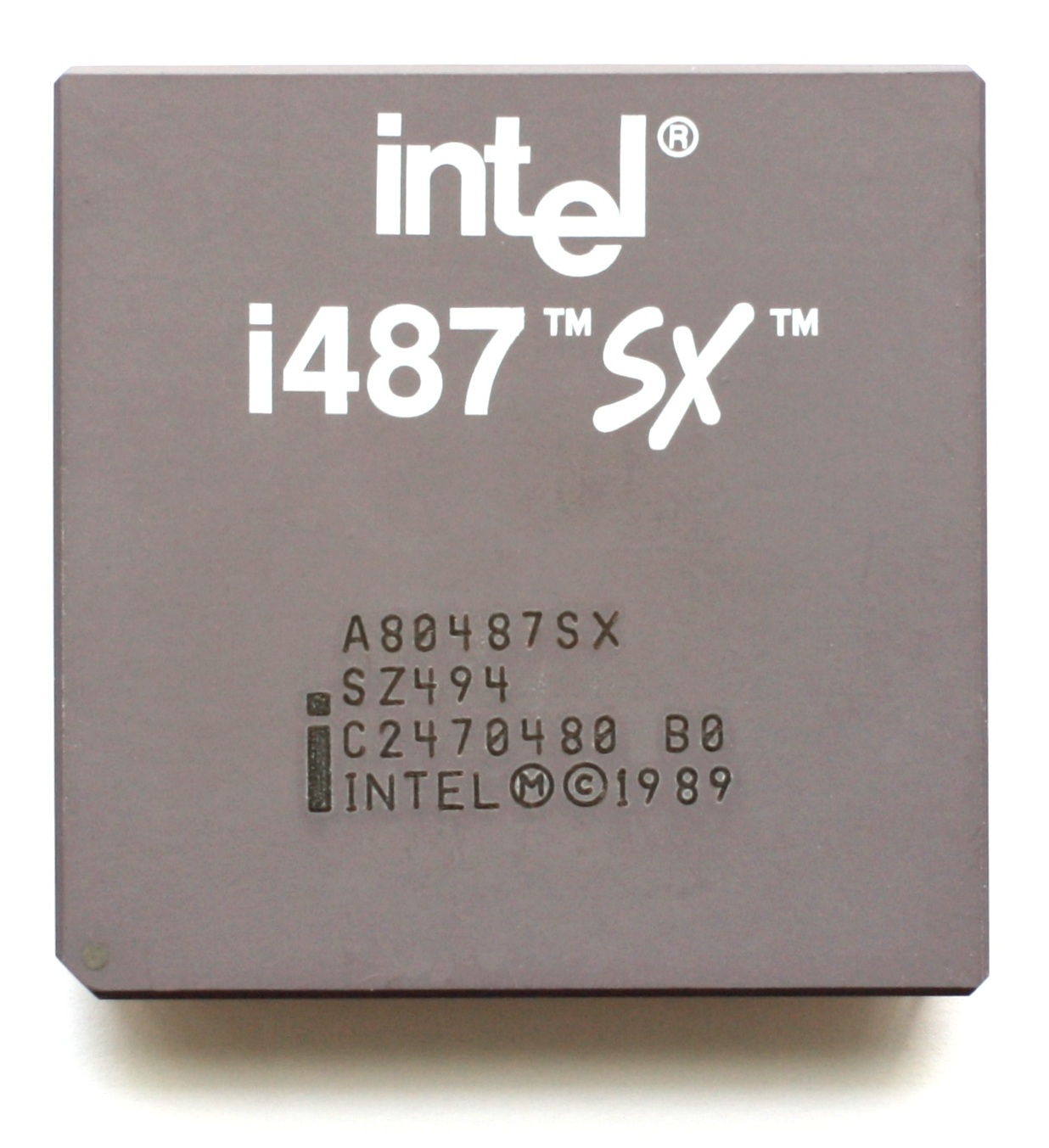
Intel 80487SX
Floating-point upgrade chip for Intel 486SX systems
Released in 1991 by Intel, the 80487SX was marketed as a math coprocessor for 486SX computers. It contained a full 486DX core that disabled the host CPU to take over all processing tasks.
- Released in 1991 as a floating-point upgrade
- Contained a full i486DX core inside
- Disabled the host CPU upon installation
- Used a unique 169-pin socket design
- Later associated with Socket 1 standard
What it is
The Intel 80487SX is a specialized integrated circuit introduced in 1991. Although sold as a floating-point unit for machines using the Intel i486SX processor, it functioned differently from earlier math chips. Instead of merely assisting with calculations, this component contained a complete i486DX implementation. When installed, it disabled the original central processing unit and assumed control of all system operations. This design allowed users to upgrade lower-end computers to full performance levels without replacing the entire motherboard.
How it came about
Intel launched this chip in 1991 to address the lack of hardware floating-point support in the i486SX line. The company marketed it as a numeric coprocessor, following the naming convention of previous x87 units. However, independent testing later revealed that the device could operate independently of the host CPU, despite manual claims to the contrary. Intel eventually acknowledged this capability. The socket used for this chip was later rebranded as Socket 1 when OverDrive processors were released.
Inside the chip
This unit utilized a unique 169-pin package with one unconnected pin. This physical key prevented insertion into standard 168-pin sockets meant for regular 486 chips. Inside, the silicon housed a full i486DX core rather than just arithmetic logic. While the instruction set remained compatible with the existing 387 standard, the integration offered better bus utilization. On-chip algorithms were also enhanced compared to earlier discrete units, providing faster numerical processing through direct hardware execution.
How it was made
Intel manufactured the 80487SX internally. The specific fabrication process node and transistor count are not detailed in the available records. The physical interface required a distinct socket layout to ensure compatibility only with intended systems. This packaging choice helped prevent accidental installation in unsupported motherboards while facilitating a straightforward upgrade path for existing 486SX owners seeking improved mathematical performance.
Where it went
Primary applications included personal computers based on the Intel i486SX processor. Users installed this chip to enable hardware-accelerated floating-point arithmetic, which was essential for scientific computing, computer-aided design, and complex simulations. Before this upgrade, such systems relied on slower software emulation for these tasks. The chip effectively transformed a budget-oriented PC into a more capable workstation by activating the dormant DX-class capabilities within the upgrade module.
Versions and family
The P23N was the primary model identifier for this component. It served as a precursor to the i486 OverDrive series, which used the same Socket 1 interface but was marketed differently. Unlike the RapidCAD upgrade kits for 386 systems, which used a dummy FPU alongside a new main processor, the 80487SX replaced the active CPU entirely. No direct successor carried the 80487 name, as later processors integrated floating-point units directly onto the main die.
Why it matters
This product clarified the distinction between marketing labels and technical reality in processor upgrades. It demonstrated that integrating a full core was a viable strategy for enhancing system performance without requiring a complete platform change. The rebranding of its socket to Socket 1 influenced future upgrade paths for Intel's fourth-generation processors. It also marked one of the final instances where a separate physical chip was used to add significant computational power to an x86 system.
Problems and reception
Initial documentation claimed the unit would not function without an i486SX present. Independent testers disproved this assertion, showing the chip could operate alone. Intel later admitted the manual was incorrect. This discrepancy did not hinder its utility but highlighted the unusual nature of the product. Users benefited from the performance boost, though the method of disabling the original CPU was a unique architectural approach compared to traditional coprocessors.


Questions people ask about Intel 80487SX
Was the 80487SX just a math coprocessor?
No, although marketed as a floating-point unit, it actually contained a complete i486DX processor core. When installed, it disabled the original CPU and took over all processing duties for the computer system.
Why did it have a different number of pins?
It used a 169-pin socket with one unconnected pin to prevent accidental insertion into standard 168-pin 486 sockets. This physical key ensured it was only installed in compatible systems designed for this specific upgrade.
Could it work without the original CPU?
Yes. Despite Intel's manual stating it required an i486SX to function, independent testing proved it could operate independently. Intel later admitted this fact, revealing the chip was essentially a full processor replacement.
Good reading and sources
The facts on this page come from the Wikipedia article "X87", written by its contributors and used under the CC BY-SA 4.0 licence, and from its Wikidata record (CC0). EveryChip rewrote the text in its own words, with AI assistance, and compares every page with the article to make sure no passage is copied. It may be reused under the same CC BY-SA 4.0 licence with a link back.
It may contain mistakes, and figures change over time. Nothing here is investment or buying advice. If something is wrong, tell us. Last refreshed 2026-11-14.
Like Intel 80487SX
All CPUs and microprocessors 🇺🇸 United StatesIntel 80486SX
A 1991 Intel 486 CPU sold without a working floating-point unitCPU · x86 · 1991
 🇺🇸 United StatesPentium
Intel's long-running x86 processor brand, from the 1993 P5 to 2023 budget partsCPU · x86 · 1993
 🇺🇸 United StatesIntel 80486
32-bit x86 CPU with pipelined execution and on-chip cache, launched 1989CPU · x86 · 1989
 🇺🇸 United StatesPentium
Intel's first superscalar x86 chip, with dual integer pipelines and a faster FPUCPU · x86 · 1993
More from Intel
All of them 🇺🇸 United StatesIntel 486DX2
A 486 CPU whose internal clock ran at twice the bus speedCPU · x86 · 1992
 🇺🇸 United StatesDEC Alpha
A 64-bit RISC architecture by Digital Equipment CorporationCPU · RISC · 1992
 🇺🇸 United StatesRealityEngine
High-end 3D graphics hardware by Silicon GraphicsGPU · Other · 1992