
ARM7
A family of 32-bit RISC cores licensed by ARM for microcontroller use
ARM7 is a group of 32-bit RISC processor cores that ARM Holdings licensed to other companies for use in microcontrollers and low-power devices. Released between 1993 and 2001, the family introduced the compact Thumb instruction set and became widely used in phones, handheld consoles and embedded systems before being superseded by ARM Cortex-M.
- 32-bit RISC core family licensed by ARM Holdings, 1993 to 2001
- ARM7DI brought JTAG on-chip debugging to ARM cores
- Thumb 16-bit instructions improved code density over earlier designs
- ARM7TDMI powered the Nokia 6110, Game Boy Advance and early iPods
- Up to 130 MIPS on a typical 0.13 µm process
What it is
ARM7 covers a set of 32-bit RISC cores designed by ARM Holdings and licensed out to chip makers rather than sold as finished silicon. The group spans several implementations, from the early ARM700 and ARM710 through to the ARM7TDMI and ARM7EJ-S. Chips built around these cores appeared from 1993 to 2001 and were aimed at microcontroller work and battery-powered electronics. The ARM7TDMI and its synthesisable sibling ARM7TDMI-S saw the widest adoption of the whole family. ARM no longer recommends the design for fresh integrated circuit projects, pointing designers towards the Cortex-M line instead.
How it came about
The original ARM7 grew out of the earlier ARM6 core and kept that design's ARMv3 instruction set. One member, the ARM7DI, brought on-chip debugging through JTAG, something the ARM6 generation lacked. Its name records the additions: a JTAG test access port for debugging, plus an ICEBreaker module able to halt the system and set hardware breakpoints and watchpoints. Later cores carried this support forward and extended it. The family appeared over the period 1993 to 2001.
Inside the chip
Every core in the group follows a Von Neumann layout, so the few versions that carry a cache keep code and data in one store instead of splitting them. ARM7TDMI provides 37 registers, 31 for general use and 6 with special jobs. Its letters stand for Thumb, Debug, Multiplier and ICE. Thumb is a 16-bit instruction set that packs programs more tightly than the 32-bit ARM set, and the core can run both. The ARM7EJ-S adds Jazelle, a mode for Java bytecodes, and takes the ARMv5TE instruction set first seen in ARM9E. Peak throughput reaches 130 MIPS on a typical 0.13 µm process.
How it was made
ARM Holdings did not fabricate or market chips itself. Instead it handed licensees a hardware description of the core, written as synthesisable Verilog RTL, along with a software toolchain and the right to sell silicon containing the design. Manufacturers could then tune the core for their own targets, such as a higher clock, minimal power draw, extra instructions or a smaller die. Which features ended up in any given part is set out in that maker's datasheet. Performance figures quoted for the family assume a 0.13 µm process.
Where it went
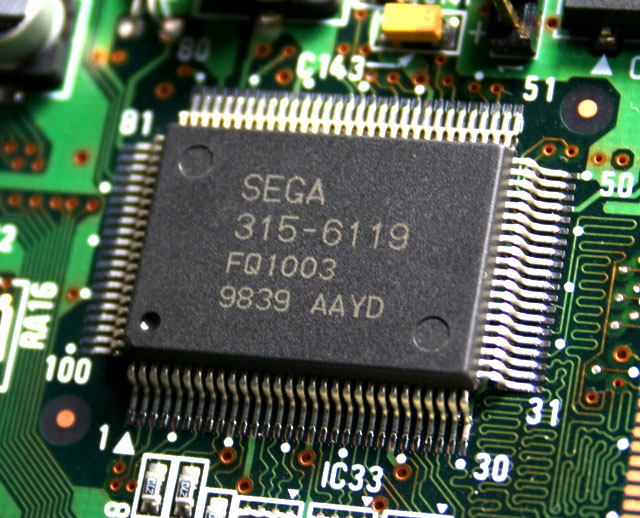
Texas Instruments put the ARM7TDMI inside the Nokia 6110, the first GSM handset built around an ARM processor, and the core went on to power Nokia models such as the 3210 and 3310. Nintendo used it in the Game Boy Advance and the DS, and Sony employed it as the mechanics controller in later PlayStation 2 consoles. Apple fitted dual-core ARM7TDMI parts into the first five iPod Classic generations, the Mini and the original Nano, and the eMate 300 laptop ran Newton OS on the family. Other products include the iRobot Roomba, Lego Mindstorms NXT, Microsoft Zune HD and the Sega Dreamcast audio coprocessor.
Versions and family
The line began with ARM700, ARM710, ARM7DI, ARM710a, ARM710T, ARM720T and ARM740T. ARM710 found a home in a CPU module for the Acorn Risc PC and inside the ARM7100 and ARM7500, among the first ARM-based system-on-chip designs. ARM7TDMI implements ARMv4T and was licensed to many chip vendors; ARM7TDMI-S is the same core supplied in synthesisable form. ARM7EJ-S implements ARMv5TE with Jazelle. Chips carrying these cores include Analog Devices AD6720/6724/6726, Atmel AT91 families, STMicroelectronics STR7, NXP LPC2100 to LPC2400, PortalPlayer PP5002 and PP5022, plus parts from Cirrus Logic, Samsung, Nuvoton and Yamaha.
Why it matters
By 2009 ARM7TDMI ranked among the most commonly deployed ARM cores and turned up in a large number of deeply embedded designs. Its introduction of Thumb showed that a 32-bit RISC core could also deliver compact code, a balance that suited phones and handhelds with little memory. The debugging features first seen on ARM7DI set a pattern that later ARM cores kept and improved. Licensing the design widely let many firms build their own chips around one core, spreading ARM7 through phones, games machines, players and robots.
Problems and reception
Some members of the family are now classed as obsolete, and ARM steers new designs to Cortex-M cores instead. Exact feature sets varied between licensees, since each manufacturer adapted the RTL, so the datasheet of the chip maker is needed to tell what a particular part contains.

Questions people ask about ARM7
What is ARM7?
It is a family of 32-bit RISC processor cores created by ARM Holdings and licensed to semiconductor firms, who build complete chips around them. The cores target microcontroller and low-power work and appeared between 1993 and 2001.
Did ARM make the chips itself?
No. ARM Holdings neither fabricated nor sold finished processors. It supplied licensees with a hardware description of the core, a software development toolset and the right to market silicon containing the design.
What did Thumb add?
Thumb is a 16-bit instruction set that stores programs more compactly than the 32-bit ARM set. ARM7TDMI supports both, so code can be dense where space matters and full width where speed matters.
Which products used ARM7?
Examples include the Nokia 6110, 3210 and 3310 phones, Nintendo's Game Boy Advance and DS, Sony's PlayStation 2, Apple's early iPods and eMate 300, the Sega Dreamcast audio processor, Roomba and Lego Mindstorms NXT.
Is ARM7 still used for new designs?
ARM no longer recommends these cores for new integrated circuit projects and points designers to the ARM Cortex-M family. Several members of the group are classed as obsolete.
Good reading and sources
The facts on this page come from the Wikipedia article "ARM7", written by its contributors and used under the CC BY-SA 4.0 licence, and from its Wikidata record (CC0). EveryChip rewrote the text in its own words, with AI assistance, and compares every page with the article to make sure no passage is copied. It may be reused under the same CC BY-SA 4.0 licence with a link back.
It may contain mistakes, and figures change over time. Nothing here is investment or buying advice. If something is wrong, tell us. Last refreshed 2026-11-14.
Like ARM7
All CPUs and microprocessors 🇯🇵 JapanV850
32-bit RISC microcontroller architecture for embedded systemsMicrocontroller · RISC · 1994
🇺🇸 United StatesStrongARM
High-performance ARM microprocessor family for portable devicesCPU · Arm · 1996
 🇬🇧 United KingdomARM9
32-bit RISC processor core family for microcontrollersMicrocontroller · Arm · 1998
 🇳🇱 NetherlandsNexperia
Brand for NXP media and mobile system-on-chipsSoC · Arm · 1999
More from ARM Holdings
All of them 🇺🇸 United StatesCyrix Cx486
x86 desktop microprocessor competing with Intel 486CPU · x86 · 1993
 🇺🇸 United StatesCyrix Cx486SLC
Hybrid x86 CPU bridging 386SX boards to 486 featuresCPU · x86 · 1992
 🇺🇸 United StatesMSP430
A 16-bit mixed-signal microcontroller family designed for very low power use.Microcontroller · Other · 1992
 🇺🇸 United States and 1 moreSuperSPARC
Sun Microsystems SPARC V8 microprocessor from 1992CPU · RISC · 1992