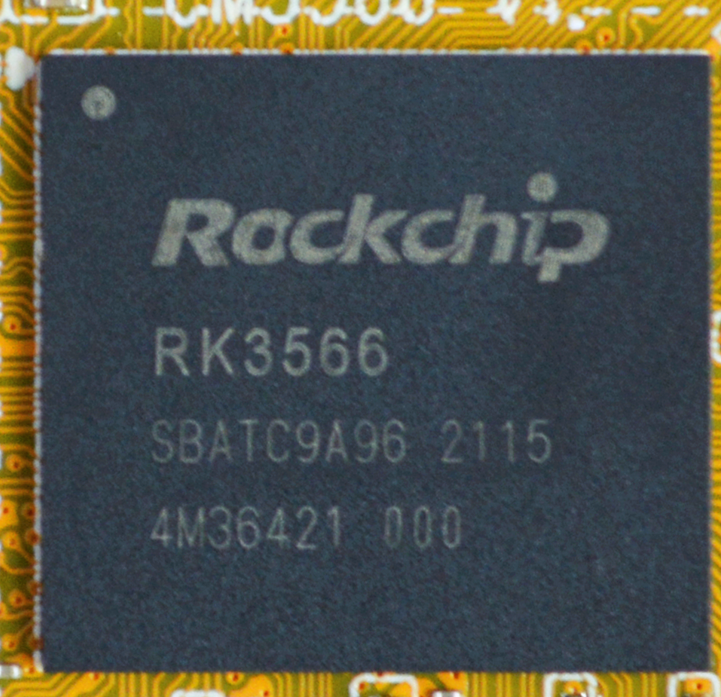
ARM Cortex-A55
Efficient 64-bit CPU core for mobile and embedded systems
Designed by Arm Holdings in Cambridge, the Cortex-A55 is a 64-bit processor core launched in 2017. It succeeds the Cortex-A53 with better efficiency and supports DynamIQ technology for flexible multi-core scaling in systems on a chip.
- Successor to the popular Cortex-A53 core
- Supports Arm DynamIQ multi-core technology
- Clock speeds range from 1.25 GHz to 2.31 GHz
- Used in Google Tensor and MediaTek Dimensity chips
What it is
The ARM Cortex-A55 is a central processing unit core that implements the ARMv8.2-A 64-bit instruction set. Arm Holdings designed it at their Cambridge centre, and production began in 2017. It functions as an efficient component within larger systems on a chip, often serving as the low-power cluster in mobile devices. The design focuses on improving energy usage and performance compared to its predecessor, making it suitable for a wide range of consumer electronics and embedded applications.
How it came about
Arm developed the Cortex-A55 to replace the widely used Cortex-A53. The goal was to deliver higher performance and better power efficiency without sacrificing compatibility. It launched alongside the Cortex-A75 as part of the first group of cores to support DynamIQ technology. This new approach allowed for more flexible scaling of multi-core processors than the previous big.LITTLE architecture, enabling designers to mix different core types more effectively.
Inside the chip
This core uses a two-wide decode in-order superscalar pipeline. In-order execution means instructions are processed strictly in the sequence they arrive, which simplifies the hardware and saves power. The design includes improved memory access and branch prediction logic over the older A53. It supports configurations with one to eight cores per cluster. Cache sizes vary by implementation, with L1 caches ranging from 32 to 128 KB per core and shared L2 and L3 caches providing additional storage.
How it was made
Arm licenses the Cortex-A55 as a semiconductor intellectual property core rather than manufacturing physical chips itself. Licensees integrate this core into their own system on a chip designs, combining it with graphics units, modems, or other components on a single die. The manufacturing process depends on the specific licensee and product, with clock speeds typically ranging from 1.25 GHz to 2.31 GHz in commercial implementations.
Where it went
Many companies use this core in their products. MediaTek includes it in Dimensity and Helio series chips for smartphones. Samsung uses it in Exynos processors. Google integrated it into the Tensor G1 and G2 chips for Pixel phones. Qualcomm created semi-custom versions called Kryo 385, 360 Silver, and 460 Silver for mid-range Snapdragon devices. It also appears in embedded systems like the Rockchip RK3566 and Intel Agilex FPGAs.
Versions and family
Qualcomm collaborated with Arm to create semi-custom variants for their Snapdragon platforms. These include the Kryo 385, Kryo 360 Silver, and Kryo 460 Silver cores. The standard Cortex-A55 serves as the successor to the Cortex-A53. It was eventually succeeded by the Cortex-A510, which introduced further efficiency gains. The core is scalable, allowing designers to use multiple clusters in a single chip.
Why it matters
The Cortex-A55 became a standard choice for mid-range and budget mobile processors due to its balance of performance and efficiency. Its support for DynamIQ technology helped shift the industry toward more flexible multi-core architectures. By improving on the ubiquitous Cortex-A53, it maintained strong software compatibility while offering tangible gains in battery life and speed for everyday tasks.
Questions people ask about ARM Cortex-A55
What is the ARM Cortex-A55?
It is a 64-bit CPU core designed by Arm Holdings for use in mobile and embedded devices. It focuses on energy efficiency and serves as a building block for systems on a chip.
How does it differ from the Cortex-A53?
The Cortex-A55 offers about 18% more performance and 15% better power efficiency than the Cortex-A53. It also features improved branch prediction and memory access capabilities.
Which phones use the Cortex-A55?
It is found in many mid-range smartphones using chips from MediaTek, Samsung, Qualcomm, and Google. Examples include devices with Dimensity, Exynos, Snapdragon, and Tensor processors.
Good reading and sources
- Official websiteOfficial site
- ARM Support RedirectorArm, Article
- Checking your browserAnandTech, Article
- ARM’s new processors are designed to power the machine-learning machinesThe Verge, Article
- Agilex™ 5 FPGAs and SoC FPGAs Are Ideal for Midrange Applications Requiring Higher Performance, Lower Power, and Smaller Form Factors - ThisIntel, Article
The facts on this page come from the Wikipedia article "ARM Cortex-A55", written by its contributors and used under the CC BY-SA 4.0 licence, and from its Wikidata record (CC0). EveryChip rewrote the text in its own words, with AI assistance, and compares every page with the article to make sure no passage is copied. It may be reused under the same CC BY-SA 4.0 licence with a link back.
It may contain mistakes, and figures change over time. Nothing here is investment or buying advice. If something is wrong, tell us. Last refreshed 2026-11-14.
Like ARM Cortex-A55
All CPUs and microprocessors 🇬🇧 United KingdomARM Cortex-A9
32-bit multi-core processor core for mobile and embedded systemsCPU · Arm · 2007
 🇺🇸 United StatesXScale
ARM-based microarchitecture for mobile and embedded systemsCPU · Arm · 2002
🇺🇸 United StatesXScale
ARM-based microarchitecture for mobile and embedded processors designed by Intel and later Marvell.CPU · Arm · 2002
More from Arm Holdings
All of them 🇬🇧 United KingdomARM Cortex-A72
64-bit ARM CPU core for mobile and embedded systemsCPU · Arm · 2015