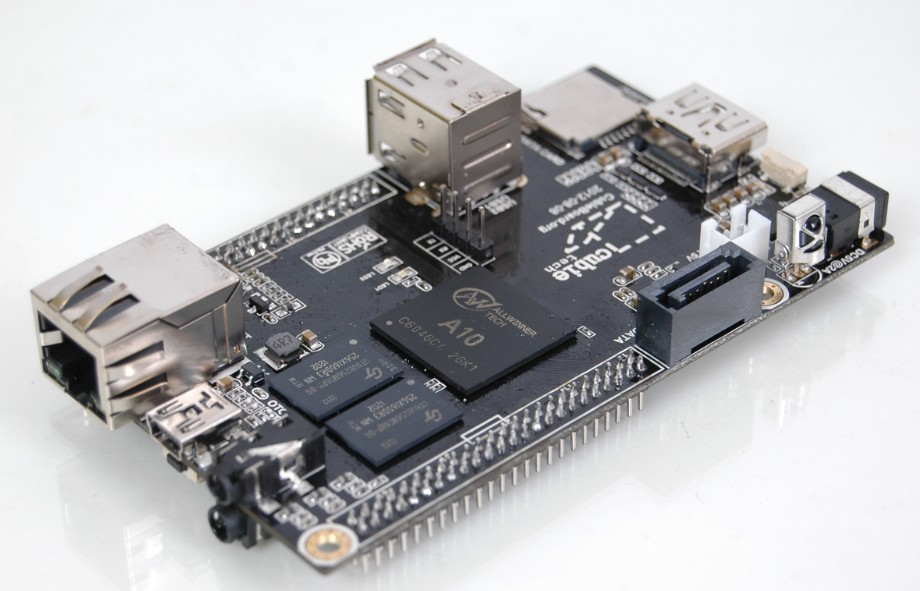
Allwinner A1X
Single-core ARM SoC family for embedded devices and single-board computers.
The Allwinner A1X is a series of system-on-chip processors designed by Allwinner Technology in Zhuhai, China. It uses the ARM Cortex-A8 core and Mali-400 GPU to power tablets, mini-PCs, and Linux boards like Cubieboard.
- Uses ARM Cortex-A8 processor and Mali-400 GPU.
- Supports Linux distros like Debian and Ubuntu from SD cards.
- Includes models A10, A13, A10s, and A12.
- Found in Cubieboard and other single-board computers.
- Successors include dual-core A20 and quad-core A31.
What it is
The Allwinner A1X represents a family of single-core system-on-chip devices created by Allwinner Technology. Based in Zhuhai, China, the company developed these chips to serve as central processing units for various consumer electronics. The lineup includes specific models such as the A10, A13, A10s, and A12. These integrated circuits combine a processor, graphics unit, and memory controllers on one silicon die. They are widely recognized for their versatility in running both Android and Linux operating systems. This flexibility has made them popular choices for hobbyists and manufacturers building custom hardware solutions.
How it came about
Allwinner Technology introduced the A1X series to address the demand for affordable, low-power computing platforms. The design team focused on integrating standard ARM architecture with robust multimedia capabilities. By supporting major Linux distributions like Debian and Ubuntu from SD cards, they enabled widespread adoption in the open-source community. The architecture is tracked under the 'sunxi' name in kernel repositories. Later iterations, such as the dual-core A20 and quad-core A31, expanded upon this foundation while maintaining pin compatibility with earlier models.
Inside the chip
At its core, the A1X utilizes the ARM Cortex-A8 processor architecture. Graphics processing is handled by the Mali-400 unit. The chip supports high-definition video decoding up to 3840x2160 resolution. It handles common codecs including H.264, VP8, and MPEG variants. Memory interfaces include DDR2 and DDR3 SDRAM alongside NAND flash storage. Connectivity options feature USB 2.0, Ethernet, HDMI, and SATA ports. Audio support spans I²S, SPDIF, and AC97 standards. The design allows for multi-channel display outputs via LVDS or RGB interfaces.
How it was made
Specific manufacturing details regarding the process node size or transistor count are not provided in the available records. Packaging types vary depending on the final device implementation, ranging from small modules to larger board-mounted components. The integration of multiple functions onto a single die reduces the overall footprint required for end products.
Where it went
Manufacturers have integrated the A1X into diverse electronic devices. Common applications include tablet computers, set-top boxes, and mini-PCs. Single-board computers like Cubieboard and Gooseberry rely heavily on the A10 variant. Other implementations include PC-on-a-stick devices and specialized boards like the Tinkerforge RED Brick. The chips also appear in budget computer projects such as CHIP. Both commercial Android devices and developer-focused Linux boards utilize this silicon.
Versions and family
The primary family consists of the A10, A13, A10s, and A12. The A10 model uniquely includes a CAN bus interface. Successors in the broader A-Series include the dual-core A20 and the quad-core A31. These newer chips use the Cortex-A7 core instead of the Cortex-A8. They offer increased processing power while remaining compatible with existing designs through pin alignment. The progression marks a shift towards higher performance within the same product ecosystem.
Why it matters
The A1X series played a significant role in the single-board computer revolution. Its affordability and Linux compatibility encouraged experimentation among developers and educators. Projects like Cubieboard demonstrated the potential of ARM-based computing outside traditional Windows environments. The 'sunxi' kernel support ensured long-term software viability. Although superseded by more powerful cores, the A1X established a reliable baseline for entry-level embedded computing in China and globally.
Problems and reception
The chips received positive attention from the open-source community for their bootable Linux capabilities. Documentation limitations exist, particularly the lack of a public programmer's manual for the A10S CPU. Kernel support has evolved, with stable drivers available for older versions but limited 3D acceleration in recent mainline releases. FreeBSD and OpenBSD support remains partial or work-in-progress for some peripherals. Despite these constraints, the hardware proved robust for its intended market segment.

Questions people ask about Allwinner A1X
What processor does the Allwinner A1X use?
The Allwinner A1X family uses the ARM Cortex-A8 as its main processor core. Graphics processing is handled by the Mali-400 unit integrated into the system-on-chip design.
Which operating systems are supported?
The chips support Android OS typically installed on flash memory. They also boot various Linux distributions such as Debian, Ubuntu, Fedora, and others from SD cards due to sunxi kernel support.
What are the main differences between the A10 and A10s?
The A10 model includes a built-in CAN bus interface which is absent in the A10s. Both share similar core architectures but may differ in connectivity options for specific industrial or automotive applications.
Who succeeded the A1X series?
The A1X was followed by more powerful chips in the Allwinner A-Series. These include the dual-core A20 and the quad-core A31, which utilize the newer Cortex-A7 architecture.
Good reading and sources
The facts on this page come from the Wikipedia article "Allwinner A1X", written by its contributors and used under the CC BY-SA 4.0 licence, and from its Wikidata record (CC0). EveryChip rewrote the text in its own words, with AI assistance, and compares every page with the article to make sure no passage is copied. It may be reused under the same CC BY-SA 4.0 licence with a link back.
It may contain mistakes, and figures change over time. Nothing here is investment or buying advice. If something is wrong, tell us. Last refreshed 2026-11-15.
Like Allwinner A1X
All systems on a chip 🇺🇸 United StatesQualcomm Snapdragon
Qualcomm's brand of ARM-based systems on chip, modems and wireless controllersSoC · Arm · 2007
 WorldRockchip RK3288
Quad-core ARM Cortex-A17 system on a chip for low-power devicesSoC · Arm · 2014
🇷🇺 RussiaBaikal CPU
Russian microprocessor line using MIPS, ARM and RISC-V coresCPU · MIPS · 2016
 WorldESP32
Low-cost microcontroller with Wi-Fi and Bluetooth by Espressif SystemsMicrocontroller · x86 · 2016
