GPU architectures
Nvidia Tesla to Blackwell, AMD GCN, RDNA and CDNA, Intel Xe, Arm Mali and Imagination PowerVR. 134 chips on EveryChip so far.
GPU architectures are the design generations of graphics and compute processors. Nvidia names each one after a scientist (Tesla, Fermi, Kepler, Pascal, Volta, Turing, Ampere, Hopper, Blackwell, Rubin), AMD uses families such as Graphics Core Next, RDNA and CDNA, and Intel has Xe. Each generation changes how the many small cores are grouped, what special units they carry and how they reach memory.
Generation by generation
Nvidia's Tesla (2006) unified the shader units and brought CUDA. Volta (2017) added tensor cores for matrix maths, Turing (2018) added ray tracing cores for realistic lighting, and Hopper (2022) and Blackwell (2024) were built for AI. AMD's Graphics Core Next (2012) served both games and compute; in 2019 and 2020 AMD split its line into RDNA for games and CDNA for data centres.
Programming models
GPU instruction sets change with each generation, so programs are written in higher-level languages such as CUDA, OpenCL, HIP or shader languages, and a driver compiles them for the chip. Nvidia's long investment in CUDA software is one reason for its lead in AI. Mobile GPUs from Arm (Mali), Imagination (PowerVR), Qualcomm (Adreno) and Apple use tile-based designs that save memory traffic.
Famous GPU architecture chips


Further reading
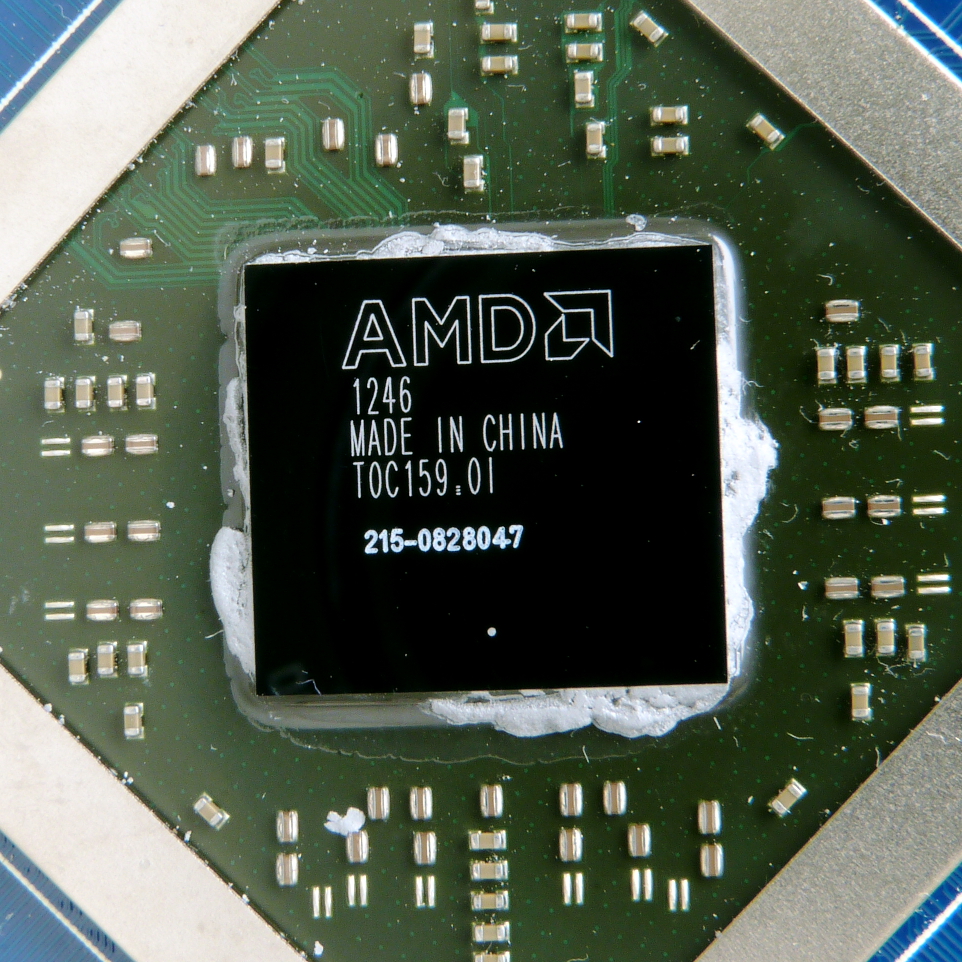 🇺🇸 United StatesRadeon HD 7000 series
AMD graphics processor family using 28 nm process and GCN architectureGPU · GPU architecture · 2012
🇺🇸 United StatesRadeon RX 400 series
AMD graphics processors using Polaris chips and GCN 4 architectureGPU · GPU architecture · 2016
🇺🇸 United StatesRadeon RX Vega
AMD graphics processors using the fifth generation GCN architectureGPU · GPU architecture · 2017
🇺🇸 United StatesIntel Data Center GPU Max
Data centre GPU for HPC and AI workloadsGPU · GPU architecture
🇺🇸 United States and 1 moreAMD Instinct MI100
CDNA architecture GPU for high-performance computing and AI workloads.GPU · GPU architecture · 2020
🇺🇸 United StatesAMD Instinct MI250X
Dual-GPU accelerator for supercomputersGPU · GPU architecture
🇨🇳 ChinaBiren BR100
AI GPU for data centre compute workloadsGPU · GPU architecture
🇺🇸 United StatesA100
Data centre GPU for AI and high-performance computing.GPU · GPU architecture · 2020
🇺🇸 United StatesNvidia B300
AI accelerator with dual-die design and 288 GB memoryGPU · GPU architecture
🇺🇸 United StatesAMD Instinct MI325X
AI accelerator with 256GB HBM3E memoryAI accelerator · GPU architecture
🇺🇸 United StatesAMD Instinct MI355X
AI accelerator using CDNA 4 architecture on a 3nm process.AI accelerator · GPU architecture · 2025
🇺🇸 United StatesAMD Instinct MI350X
Air-cooled AI accelerator using CDNA4 architecture and 3nm process.AI accelerator · GPU architecture · 2025
🇺🇸 United StatesAMD Instinct MI300X
AI accelerator GPU with 192GB HBM3 memoryGPU · GPU architecture · 2023
🇺🇸 United States and 1 moreNvidia H20
AI accelerator chip for the Chinese marketGPU · GPU architecture
🇺🇸 United StatesNvidia L4
Low-profile data centre GPU for AI and videoGPU · GPU architecture
🇺🇸 United StatesGH200 Grace Hopper Superchip
Combined Arm CPU and Hopper GPU for AI and HPC workloadsCPU · Arm
🇺🇸 United StatesB200
AI GPU with 208 billion transistors for trillion-parameter modelsGPU · GPU architecture
🇺🇸 United StatesNvidia H100
AI and HPC accelerator based on the Hopper architectureGPU · GPU architecture
🇺🇸 United StatesNvidia L40S
Data centre GPU for AI and graphics workloadsGPU · GPU architecture · 2023
🇺🇸 United StatesNvidia H200
AI GPU with 141 GB of HBM3e memoryGPU · GPU architecture · 2023
🇺🇸 United StatesRubin CPX
AI GPU for massive-context inference with GDDR7 memoryGPU · GPU architecture · 2026
🇺🇸 United StatesTesla V100
Nvidia Volta GPU for AI and HPC data centresGPU · GPU architecture · 2017
WorldNVENC
Dedicated video encoding hardware in Nvidia GPUsGPU · GPU architecture · 2012
 🇺🇸 United StatesIntel 2700G
Mobile graphics co-processor for XScale PXA27xGPU · GPU architecture · 2004
 WorldNvidia GRID
GPU family for virtualization and cloud gamingGPU · GPU architecture · 2008
 🇺🇸 United States and 1 moreLatte
AMD Radeon-based graphics chip for the Nintendo Wii U consoleGPU · GPU architecture · 2012
🇯🇵 JapanULTRAY2000
Concept GPU by DMP with MAESTRO lighting techGPU · GPU architecture · 2005
 WorldSiS 6326
Low-cost GPU for corporate motherboards and basic 3D tasks.GPU · GPU architecture · 1997
 WorldGeForce 100 series
OEM rebranded Tesla graphics cards from 2009GPU · GPU architecture · 2009
 🇺🇸 United StatesGeForce 800M series
Nvidia laptop graphics chips from 2014 using Fermi, Kepler and Maxwell designs.GPU · GPU architecture · 2014
 🇺🇸 United StatesHopper
Nvidia datacentre GPU microarchitecture for AI and high-performance computing.GPU · GPU architecture · 2022
WorldQuadro Plex
External multi-GPU box for professional 3D workGPU · GPU architecture
🇺🇸 United StatesAMD FireStream
GPGPU co-processor cards for supercomputing and stream processing.GPU · GPU architecture · 2006
 🇺🇸 United StatesRIVA TNT
Dual-pipeline PC graphics chip from NvidiaGPU · GPU architecture · 1998
 🇺🇸 United StatesBlackwell
Nvidia GPU microarchitecture for AI and gamingGPU · GPU architecture · 2024
Photo credits on this page
The small pictures above come from Wikimedia Commons under free licences. Some are cropped to fit.
- Intel 2700G: Pinchies, CC BY-SA 4.0, source
- Nvidia GRID: Phiarc, CC BY-SA 4.0, source
- Tesla: Hyins, Public domain, source
- Fermi: Department of Energy-Office of Public Affairs, restored by Yann, Public domain, source
- Pascal: Fritzchens Fritz, CC0, source
- Graphics Core Next: AMD, Public domain, source
- RDNA: Fritzchens Fritz, CC0, source
- Radeon HD 7000 series: Liam McSherry, CC BY-SA 4.0, source
- RIVA TNT: Raimond Spekking, CC BY-SA 4.0, source
- SiS 6326: Henry2106, CC BY-SA 4.0, source
- GeForce 100 series: Sgroey, CC BY-SA 4.0, source
- GeForce 800M series: PantheraLeo1359531, CC BY 4.0, source
- Hopper: 极客湾Geekerwan, CC BY 3.0, source
- Blackwell: 极客湾Geekerwan, CC BY 3.0, source
- Latte: Takimata (edited by: Tokyoship ), CC BY-SA 3.0, source