Early 8-bit families
The 8008, 8080, 6800, 6502, Z80 and 6809: the chips of the first home computers. 34 chips on EveryChip so far.
The early 8-bit processors of the 1970s brought computing to homes and small businesses. An 8-bit processor works on numbers of 8 bits, values from 0 to 255, at a time. Intel's 8008 (1972) and 8080 (1974), Motorola's 6800 (1974), MOS Technology's 6502 (1975) and Zilog's Z80 (1976) ran the first personal computers, arcade games and consoles. Some are still made today as cores inside other chips.
The home computer boom
The Altair 8800 of 1975 used the 8080. The 6502, far cheaper than its rivals when launched, went into the Apple II, the Commodore PET and 64, the BBC Micro and the NES. The Z80, which ran 8080 software, powered the TRS-80, the ZX Spectrum, MSX computers and many CP/M business machines. These chips had a few thousand transistors and ran at 1 to 4 MHz.
Family ties
Many of these designs were related by people. Federico Faggin, who led the 4004 and 8080 at Intel, founded Zilog to make the Z80. Chuck Peddle and others left Motorola's 6800 team to design the 6502 at MOS Technology. Motorola's 6809 of 1978 was among the most advanced 8-bit chips. In the Soviet Union, clones such as the KR580VM80A copied the 8080.
Famous 8-bit chips




Still to be written: Motorola 6809.
Further reading

Photo credits on this page
The small pictures above come from Wikimedia Commons under free licences. Some are cropped to fit.
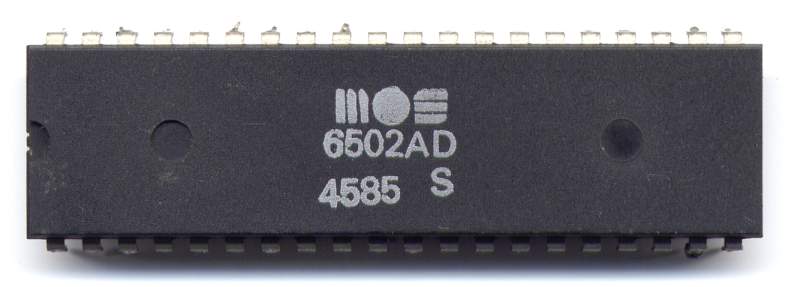
- MOS Technology 6502: Dirk Oppelt, CC BY-SA 3.0, source
- Motorola 6800: Swtpc6800 en:User:Swtpc6800 Michael Holley, Public domain, source
- Intel 8080: Christian Bassow, CC BY-SA 4.0, source
- HuC6280: The original uploader was Baz1521 at Japanese Wikipedia ., CC BY-SA 3.0, source
- Intel 8008: Konstantin Lanzet, CC BY-SA 4.0, source
- KR580VM80A: Konstantin Lanzet, CC BY-SA 3.0, source
- Zilog Z80: User Baz1521 on ja.wikipedia, CC BY-SA 3.0, source