Image and other sensors
CCD and CMOS image sensors, MEMS motion sensors and the eyes of cameras and phones. 25 chips on EveryChip so far.
Sensor chips turn the physical world into electrical signals. Image sensors, made of millions of light-sensitive pixels, are the eyes of cameras and phones. MEMS sensors (micro-electro-mechanical systems) have tiny moving structures etched in silicon that measure motion, pressure or sound. A modern phone carries several cameras, an accelerometer, a gyroscope, microphones and more, each built on chip technology.
CCD and CMOS image sensors
The charge-coupled device (CCD), invented at Bell Labs in 1969, collects light as charge in each pixel and shifts it out row by row. CMOS image sensors, developed into practical form at NASA's Jet Propulsion Laboratory in the 1990s, put an amplifier in every pixel and can be made in ordinary chip fabs. CMOS replaced CCD in most cameras by the 2010s. Sony is the largest image sensor maker.
Stacked and backside sensors
Backside illumination flips the sensor so light reaches the pixels without passing through the wiring, which helps in dim light. Stacked sensors bond the pixel layer to a separate logic chip underneath, allowing faster readout. MEMS chips, such as Texas Instruments' digital micromirror device, use the same fab methods to build moving parts measured in micrometres.
Famous sensor chips

Further reading

Photo credits on this page
The small pictures above come from Wikimedia Commons under free licences. Some are cropped to fit.
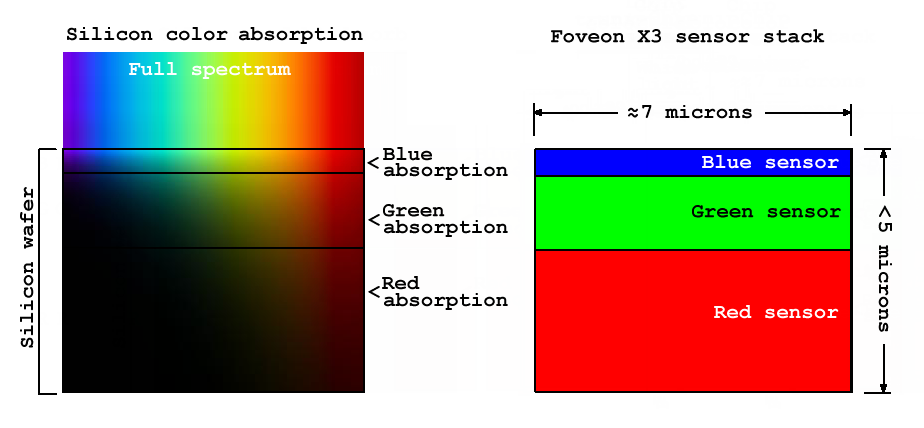
- Foveon X3 sensor: Anoneditor at English Wikipedia, CC BY-SA 3.0, source
- Event camera: Auledas, CC BY 4.0, source
- Digital micromirror device: mitopencourseware, CC BY-SA 4.0, source