FPGAs and programmable logic
Xilinx Virtex and Spartan, Altera Stratix and Cyclone, Lattice: logic you can rewire. 16 chips on EveryChip so far.
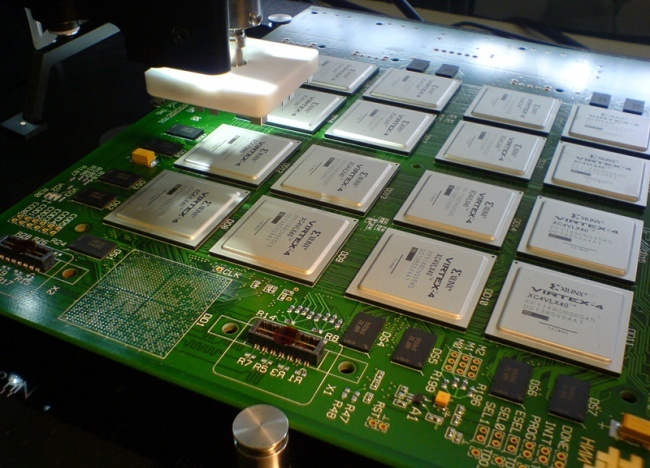
A field-programmable gate array (FPGA) is a chip whose logic can be rewired after it is made. It contains a large grid of small configurable blocks and a web of programmable connections, plus memory blocks and multipliers. Loading a configuration file turns it into a custom circuit, such as a network filter, a radar signal processor or a prototype of a future chip. Xilinx made the first commercial FPGA, the XC2064, in 1985.
Why rewire hardware
A custom chip, or ASIC, is faster and cheaper per unit but costs a great deal to design and takes a year or more to make. An FPGA can be programmed in hours and changed in the field, which suits small volumes, changing standards and prototypes. FPGAs are used in telecom base stations, test equipment, aerospace, high-frequency trading and to emulate chip designs before they are built.
The makers
Xilinx and Altera led the market for decades. Intel bought Altera in 2015 and later made it independent again, selling a majority stake to the investment firm Silver Lake in 2025. AMD completed its purchase of Xilinx in 2022. Lattice Semiconductor and Microchip make smaller, low-power FPGAs. Modern FPGAs often include Arm processor cores, becoming programmable systems on a chip.
Famous FPGA chips
Further reading

Photo credits on this page
The small pictures above come from Wikimedia Commons under free licences. Some are cropped to fit.
- Virtex: Антракт, CC BY-SA 4.0, source
- AI Engine: Dmitry Grigoriev, CC BY 2.0, source