
S3 ViRGE
Early mass-market 2D and 3D graphics accelerator chip from S3.
S3 introduced the ViRGE in 1996 as its first attempt at 3D graphics for personal computers. It combined strong 2D Windows performance with basic 3D acceleration, aiming to compete with emerging dedicated 3D hardware while maintaining compatibility with existing 2D applications.
- Launched in 1996 as S3's first 3D graphics chip.
- Benchmarked as fastest DRAM-based Windows accelerator.
- Supported S3D API for optimized game performance.
- ViRGE/DX added full-speed trilinear filtering.
- Replaced by Savage 3D in 1998.
What it is
The S3 ViRGE was a graphics chipset launched in 1996 by S3, Inc. It served as one of the first accelerators to handle both two-dimensional and three-dimensional graphics for the mainstream PC market. The chip integrated a VGA controller, a RAMDAC, and a 3D engine into a single unit. While it excelled at standard Windows tasks and DOS applications, its 3D capabilities were limited compared to later dedicated hardware. It targeted original equipment manufacturers who needed a cost-effective upgrade from previous 2D-only solutions.
How it came about
S3 developed the ViRGE in response to growing demand for real-time 3D rendering on PCs, driven by consoles like the Sony PlayStation. Before this, CPUs handled 3D graphics via software, which lacked speed and visual quality. S3 aimed to leverage its dominance in 2D acceleration to enter the 3D space. The company marketed the chip with an S3D standard, encouraging game developers to optimize titles for the hardware. Despite brand prestige, the chip struggled to keep pace with rapid industry changes and new competitors.
Inside the chip
The architecture prioritized 2D functions, leaving limited silicon area for 3D tasks. It supported texture mapping, Z-buffering, and perspective correction, but performance dropped when advanced features like fogging or bilinear filtering were enabled. The ViRGE/325 model clocked its core and memory at 80 MHz, using a DRAM interface. Later variants like the DX improved perspective correction and added trilinear filtering. The chip included video playback support for formats such as MPEG-1 and Cinepak, along with hardware-assisted scaling and blending.
How it was made
The ViRGE/325 used a 208-pin PQFP package, while the high-end ViRGE/VX utilized a 288-pin BGA package. The VX model featured a faster RAMDAC running at 220 MHz to support higher resolutions, though it suffered from slower core clock speeds. Memory configurations ranged from 2 to 8 MiB, using either DRAM or VRAM depending on the variant.
Where it went
The chip found widespread adoption in OEM PCs as a direct replacement for the Trio64 family. It delivered strong performance in Microsoft Windows and DOS environments, making it suitable for business and general computing. Gamers used it for titles that supported the S3D API, such as Tomb Raider and Descent II. However, it lacked OpenGL support and performed poorly in Direct3D benchmarks, limiting its appeal in the high-end gaming segment where competitors like 3dfx thrived.
Versions and family
The family included several models released between 1995 and 2000. The ViRGE/325 was pin-compatible with the Trio64V+. The ViRGE/VX offered higher resolution support via VRAM. The ViRGE/DX improved 3D rendering with better perspective correction, and the ViRGE/GX added support for SGRAM. The GX2 was among the first to support the AGP bus, though it did not fully utilize its features. The Trio3D derivative remained in production even after the Savage 3D replaced the main line.
Why it matters
The ViRGE helped transition the PC market from pure 2D acceleration to integrated 3D capabilities. It demonstrated the challenges established 2D vendors faced when adapting to real-time 3D rendering requirements. Although it sold well in volume markets, it could not compete with specialized 3D cards in performance-critical segments. Its legacy includes early implementation of hardware video playback and the S3D marketing initiative, which briefly unified developer support around S3 hardware.
Problems and reception
Reviewers noted the chip's excellent 2D speed and Windows acceleration, ranking it highly among DRAM-based cards. However, its 3D performance was considered lackluster, often matching only entry-level CPU software rendering when complex effects were active. The lack of OpenGL support and poor Direct3D speeds prevented it from gaining traction among enthusiasts. Industry shifts toward dedicated 3D processors eventually relegated S3 to less demanding market sectors.
Questions people ask about S3 ViRGE
Was the S3 ViRGE good for gaming?
It handled basic 3D games with S3D support reasonably well, but struggled with advanced effects. Performance often matched software rendering on entry-level CPUs when features like fogging were enabled, making it inferior to dedicated 3D cards.
What is the difference between ViRGE/325 and ViRGE/VX?
The 325 used DRAM and clocked at 80 MHz, offering fast 2D performance. The VX used VRAM and had a faster RAMDAC for high resolutions, but its slower core clock made 3D rendering even slower than the cheaper 325 model.
Did the ViRGE support AGP?
The ViRGE/GX2 model supported the AGP bus interface, but primarily for electrical compliance. It did not make substantial use of AGP features, which were better implemented in the subsequent Savage 3D chipset.
Good reading and sources
The facts on this page come from the Wikipedia article "S3 ViRGE", written by its contributors and used under the CC BY-SA 4.0 licence, and from its Wikidata record (CC0). EveryChip rewrote the text in its own words, with AI assistance, and compares every page with the article to make sure no passage is copied. It may be reused under the same CC BY-SA 4.0 licence with a link back.
It may contain mistakes, and figures change over time. Nothing here is investment or buying advice. If something is wrong, tell us. Last refreshed 2026-11-14.
Like S3 ViRGE
All graphics processors 🇨🇦 CanadaATI Rage
Graphics chipset series by ATI with 2D, video and 3D accelerationGPU · GPU architecture · 1996
 🇺🇸 United StatesRIVA 128
Nvidia's first successful consumer 3D graphics accelerator chipGPU · GPU architecture · 1997
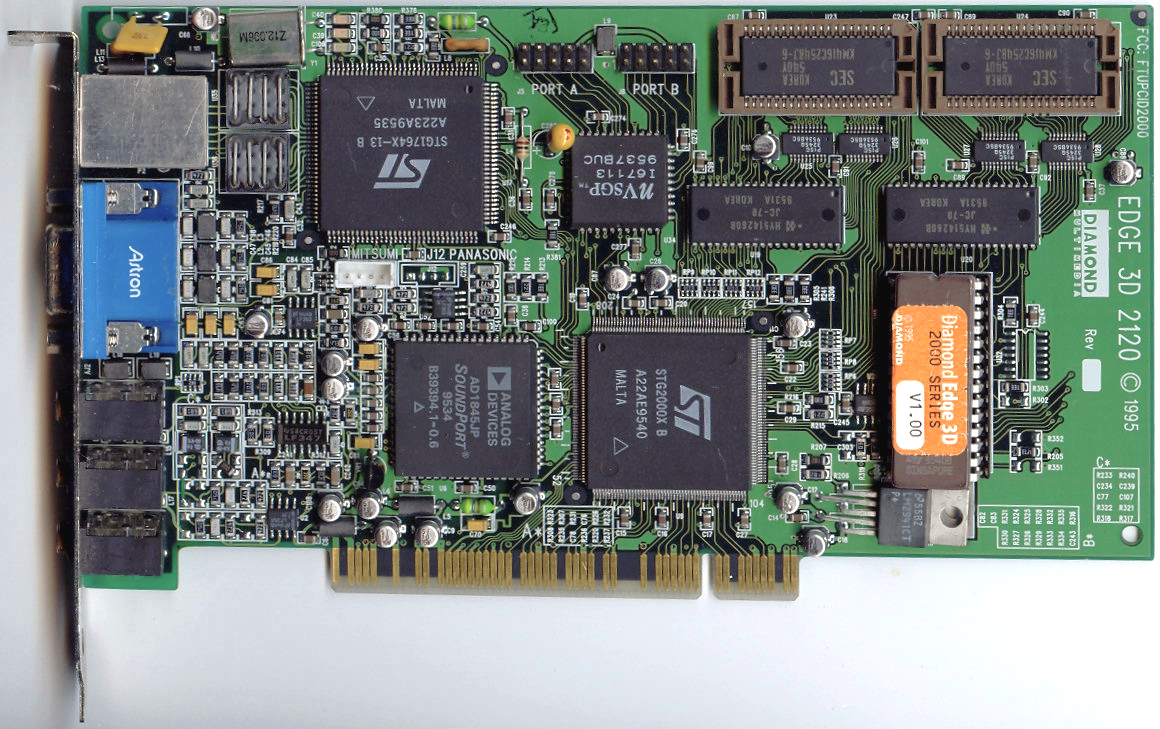 🇺🇸 United StatesNV1
Nvidia's first graphics accelerator with quadratic mapping and integrated audio.GPU · GPU architecture · 1995
 🇺🇸 United StatesRIVA TNT
Nvidia dual-texel graphics accelerator for PCsGPU · GPU architecture · 1998

