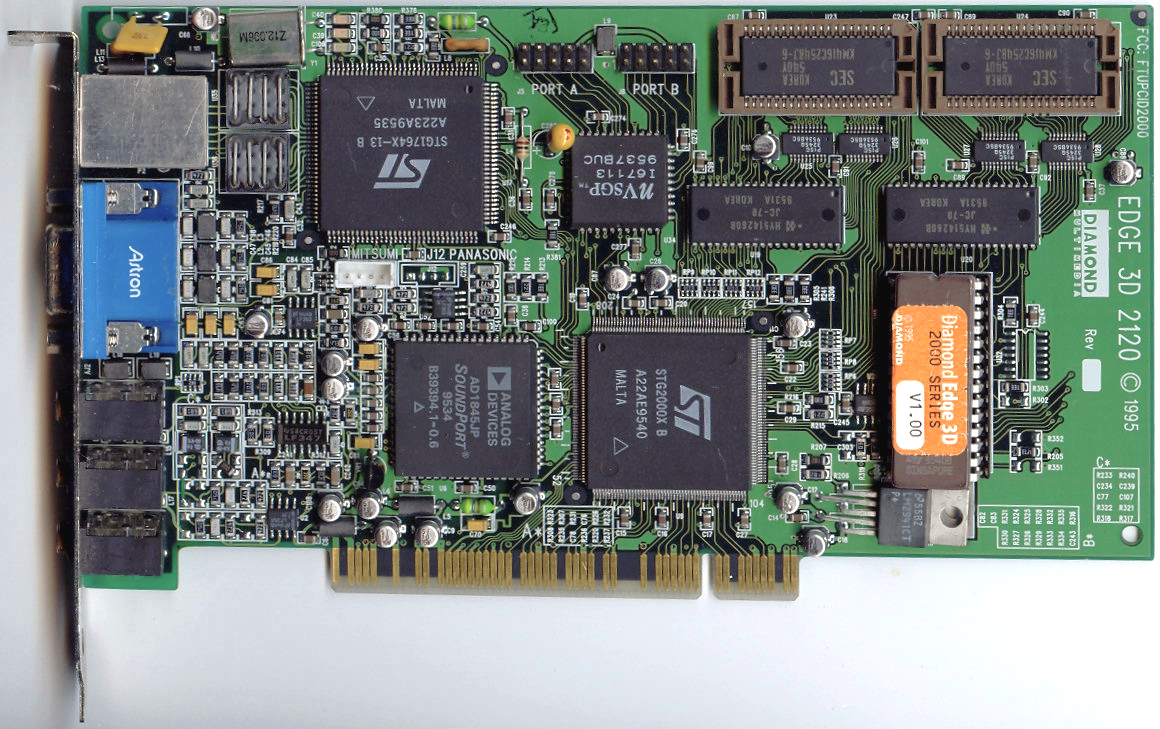
NV1
Nvidia's first graphics accelerator with quadratic mapping and integrated audio.
The NV1 was Nvidia's debut graphics chip, launched in May 1995. Manufactured by SGS-Thomson, it used quadratic texture mapping instead of triangles. The card included a sound processor and Sega controller ports. It failed commercially after Microsoft chose triangle-based DirectX standards.
- First Nvidia graphics chip, launched in May 1995
- Used quadratic texture mapping instead of triangles
- Integrated 32-channel sound and Sega controller ports
- Manufactured by SGS-Thomson on a 500 nm process
- Failed due to Microsoft DirectX triangle standard
What it is
The NV1 is the first graphics accelerator developed by Nvidia. Introduced in May 1995, it arrived as a multimedia PCI expansion card for IBM PC compatible systems. SGS-Thomson Microelectronics manufactured the silicon, often labeling it STG2000. Diamond Multimedia marketed the retail version as the Diamond Edge 3D. This chip distinguished itself by using quadratic texture mapping rather than the triangular polygons common in rival hardware. It also integrated a 32-channel sound processor and joystick ports, aiming to replace separate audio and graphics cards.
How it came about
Nvidia designed the NV1 to leverage its relationship with Sega, facilitating ports from the Saturn console. The architecture relied on quadratic surfaces, which differed from industry norms. Shortly after launch, Microsoft announced DirectX would support only triangle primitives. This decision marginalized the NV1, as software compatibility became difficult. Competitors like S3 Graphics and Matrox offered cheaper triangle-based accelerators. Diamond Multimedia wrote off significant inventory in 1996 due to poor sales. Nvidia ceased selling the chip in early 1996, recognizing the market shift away from its unique rendering method.
Inside the chip
The chip combined 2D and 3D graphics cores with video memory. Its defining feature was quadratic texture mapping, which rendered curved surfaces efficiently but struggled with standard polygon routines. The card included a playback-only sound engine with General MIDI support. Physical connections featured a gameport and two Sega Saturn controller inputs. This all-in-one approach increased manufacturing costs. While the 3D performance was credible for quadratic shapes, the 2D speed lagged behind high-end contemporaries. The audio quality received mixed reviews, failing to match dedicated Sound Blaster cards popular at the time.
How it was made
SGS-Thomson Microelectronics produced the NV1 using a 500 nanometre process node. The resulting silicon was mounted on PCI cards for desktop computers. The design integrated multiple functions, including graphics, audio, and input handling, onto a single board. This integration required more complex circuitry than simple graphics accelerators. The manufacturing choice reflected Nvidia's ambition to create a comprehensive multimedia solution. However, the added complexity contributed to higher retail prices compared to specialized components available from other vendors.
Where it went
The NV1 targeted PC gamers and multimedia enthusiasts. It supported titles ported from the Sega Saturn, such as Panzer Dragoon and Virtua Fighter Remix. Other compatible games included Daytona USA and Twisted Metal. The card aimed to simplify PC builds by replacing separate sound and graphics hardware. Despite this goal, most users already owned audio cards and preferred keeping their existing setups. The requirement for specific quadratic-compatible games limited its appeal. As DirectX adoption grew, fewer new titles supported the NV1 native rendering mode.
Versions and family
Nvidia planned a successor called NV2, which continued the quadratic architecture. Sega considered it for the Dreamcast console but ultimately rejected the technology in favor of triangle-based PowerVR2. Nvidia abandoned the NV2 project due to lack of demand and industry standardization on triangles. The actual successor to the NV1 was the RIVA 128, also known as NV3. This next chip adopted triangle primitives and removed the integrated audio features, aligning with Direct3D standards and achieving commercial success.
Why it matters
The NV1 demonstrated the risks of betting against emerging industry standards. Its failure taught Nvidia the importance of aligning with major software APIs like DirectX. The loss forced the company to pivot quickly to triangle-based rendering. This strategic shift led to the successful RIVA 128. The NV1 remains a notable example of early 3D acceleration experimentation. It highlighted the difficulties of proprietary rendering methods in a market moving toward open standards. The integrated multimedia concept preceded later unified architectures but was ahead of its time.
Problems and reception
Reviewers found the 3D performance credible but noted the difficulty of working with quadratic maps. The audio section received average marks, with General MIDI support viewed as insufficient for high-end users. Critics pointed out the high cost relative to buying separate components. The inclusion of Saturn ports was seen as niche given the console's limited PC presence. Market reception turned negative after the DirectX announcement. Retailers faced unsold stock, leading to write-offs. The product was viewed as an interesting but flawed attempt at integration.


Questions people ask about NV1
Why did the NV1 fail in the market?
Microsoft announced that DirectX would exclusively support triangle primitives. The NV1 used quadratic mapping, making it incompatible with the new standard. This lack of software support, combined with high costs, led to poor sales.
What made the NV1 different from other graphics cards?
It used quadratic texture mapping for 3D rendering instead of triangles. It also integrated a sound card and Sega Saturn controller ports, marketing itself as a complete multimedia solution rather than just a graphics accelerator.
Who manufactured the NV1 chip?
SGS-Thomson Microelectronics, now known as STMicroelectronics, manufactured the NV1. They sometimes labeled the chip as the STG2000. Diamond Multimedia sold the final retail card under the name Diamond Edge 3D.
Did the NV1 support Sega Saturn games?
Yes, the card had ports for two Sega Saturn controllers. This allowed players to use Saturn gamepads on PC. Several Saturn titles, such as Panzer Dragoon, were ported to the PC platform specifically for the NV1.
Good reading and sources
The facts on this page come from the Wikipedia article "NV1", written by its contributors and used under the CC BY-SA 4.0 licence, and from its Wikidata record (CC0). EveryChip rewrote the text in its own words, with AI assistance, and compares every page with the article to make sure no passage is copied. It may be reused under the same CC BY-SA 4.0 licence with a link back.
It may contain mistakes, and figures change over time. Nothing here is investment or buying advice. If something is wrong, tell us. Last refreshed 2026-11-14.
Like NV1
All graphics processors 🇺🇸 United StatesRIVA 128
Nvidia's first successful consumer 3D graphics accelerator chipGPU · GPU architecture · 1997
 🇺🇸 United StatesS3 Savage
PC graphics chipset series by S3 GraphicsGPU · GPU architecture · 1998
🇺🇸 United StatesCelsius
Nvidia GPU microarchitecture from 1999GPU · GPU architecture · 1999
 🇺🇸 United StatesRIVA TNT2
Nvidia graphics chip from 1999 with dual pipelinesGPU · GPU architecture · 1999
More from Nvidia
All of them WorldARM7
A family of 32-bit RISC cores licensed by ARM for microcontroller useCPU · Arm · 1993
🇺🇸 United StatesVPro
SGI workstation graphics architecture and chipset familyGPU · Other · 1997
 🇺🇸 United StatesRIVA TNT
Nvidia dual-texel graphics accelerator for PCsGPU · GPU architecture · 1998
 🇺🇸 United StatesRIVA TNT
Dual-pipeline PC graphics chip from NvidiaGPU · GPU architecture · 1998