PicoBlaze
Compact 8-bit soft processor core for Xilinx FPGAs
PicoBlaze is a series of small 8-bit processor cores designed by Xilinx for use within their field-programmable gate arrays. Created by Ken Chapman, these cores offer deterministic performance and low resource usage, making them suitable for embedded control tasks on specific hardware.
- Uses only 96 FPGA slices for implementation
- Executes all instructions in two clock cycles
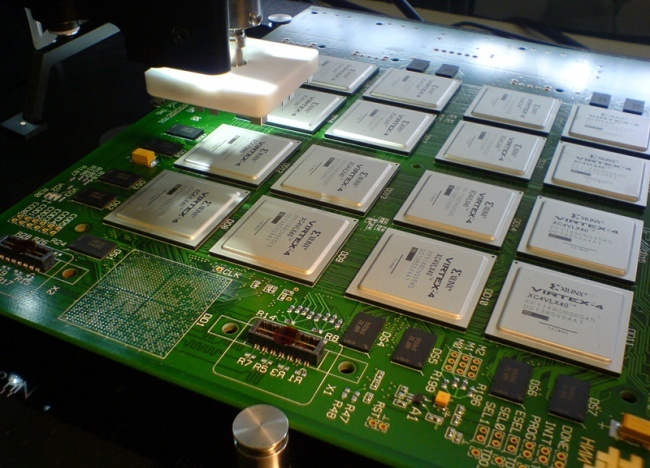
- Reaches 100 MIPS on Virtex 4 family devices
- Originally named KCPSM by designer Ken Chapman
What it is
PicoBlaze refers to a group of three soft processor cores developed by Xilinx. These units are intended for integration into the company’s field-programmable gate arrays and complex programmable logic devices. The design relies on an eight-bit reduced instruction set computing architecture. It achieves processing speeds reaching one hundred million instructions per second when deployed on the Virtex 4 family of chips. The system provides eight-bit ports for both data and addresses, allowing connection to various peripheral components. Users may employ these cores without fee, provided they remain on Xilinx hardware, and the package includes necessary development software.
How it came about
The original name for this design was KCPSM, an acronym for Constant Coded Programmable State Machine. It was previously known as Ken Chapman’s PSM. Ken Chapman, a systems designer at Xilinx, created and built the microcontroller. The project evolved into the PicoBlaze series, maintaining its focus on efficient implementation within programmable logic structures. Third-party implementations such as PacoBlaze and PauloBlaze have since emerged under open licenses, extending the reach of the original concept beyond proprietary tools.
Inside the chip
The architecture separates instruction sequencing from execution to save space. The sequencing side handles the program counter, call-return stack, and interrupt enable bit. The execution side contains the arithmetic logic unit, register file, and scratchpad random access memory. Only zero and carry status bits move from execution to sequencing during conditional jumps. Absolute addresses are required for all jumps and calls because the sequencer lacks an adder. This structure prevents computed jumps or function pointers. The core uses two clock cycles per instruction, ensuring predictable timing. Interrupts respond within five cycles. Two cores can share a single instruction memory block due to dual-ported hardware features.
How it was made
Xilinx states that the core occupies only ninety-six slices on an FPGA. This compact footprint results from the rigid division between control logic and data processing. The design does not support relative branches or position-independent code. Programmers cannot inspect the stack pointer or the contents of the thirty-one entry stack. The instruction set lacks modes for stack-based calling conventions, requiring two instructions for push or pop operations. This makes the core less suitable for compiled languages like C, but well matched for hand-optimized register-based code or Forth-like data stacks if the sixty-four byte scratchpad is sufficient.
Where it went
These processors serve in embedded control applications where small size and deterministic behavior are critical. They connect to a wide range of peripherals via their eight-bit ports. The assembly language can be challenging for simple parsers because tokens like enable and disable act as both mnemonics and modifiers for the returni instruction. Developers use tools from Mediatronix or other third parties, alongside official Xilinx resources. Implementations exist in LabVIEW FPGA and on starter boards like the Spartan 3E.
Versions and family
The series includes three distinct cores. Open source clones include PacoBlaze, a behavioral Verilog version released under the BSD License, and PauloBlaze, a VHDL model under the Apache License compatible with the kcpsm6 instruction set. NanoBlaze offers a VHDL model with configurable sizes. Assemblers and simulators such as pBlazASM, Opbasm, and kpicosim support development across Linux, Windows, and Mac platforms. The original KCPSM3 and KCPSM6 versions form the basis for many of these derivative tools and models.
Why it matters
The design demonstrated how minimal logic resources could deliver useful processing power within programmable devices. Its deterministic execution model appealed to engineers needing precise timing control. The availability of free cores encouraged widespread adoption for simple control tasks. Open source derivatives extended its utility to non-Xilinx environments and alternative hardware description languages. The architecture remains a reference for compact soft-core implementations in field-programmable gate arrays.
Questions people ask about PicoBlaze
What is the PicoBlaze processor?
It is a series of small eight-bit soft processor cores made by Xilinx. They run inside field-programmable gate arrays and use a reduced instruction set architecture for efficient control tasks.
Can I use PicoBlaze on non-Xilinx chips?
The official license allows free use only on Xilinx devices. However, open source clones like PacoBlaze and PauloBlaze exist under BSD and Apache licenses for broader compatibility.
How fast does the PicoBlaze run?
Performance depends on the host device. On the Virtex 4 FPGA family, it can reach speeds of up to one hundred million instructions per second.
Is PicoBlaze good for C programming?
No, it is poorly suited for compiled languages like C. It lacks function pointers and efficient stack operations, making hand-optimized assembly or Forth-like approaches more effective.
Good reading and sources
The facts on this page come from the Wikipedia article "PicoBlaze", written by its contributors and used under the CC BY-SA 4.0 licence, and from its Wikidata record (CC0). EveryChip rewrote the text in its own words, with AI assistance, and compares every page with the article to make sure no passage is copied. It may be reused under the same CC BY-SA 4.0 licence with a link back.
It may contain mistakes, and figures change over time. Nothing here is investment or buying advice. If something is wrong, tell us. Last refreshed 2026-11-14.
Like PicoBlaze
All microcontrollersMore from Xilinx
All of them 🇺🇸 United StatesAI Engine
AMD hardware architecture for AI inference and signal processingAI accelerator · VLIW
 🇺🇸 United StatesVirtex
High-performance FPGA family by AMD and XilinxFPGA · Other · 1999
🇺🇸 United StatesMicroBlaze
Soft microprocessor core for Xilinx FPGAsFPGA · RISC · 2002
 🇺🇸 United StatesRyzen
AMD's multi-core x86-64 CPU brand built on the Zen microarchitectureCPU · x86 · 2016