
NEC μPD7220
Early single-chip graphics display controller for bit-mapped screens
The NEC μPD7220 is a video display controller and graphics processing unit released in 1981. It enabled efficient Kanji support and hardware-accelerated drawing on early personal computers like the NEC PC-9801.
- Mass production started in December 1981
- Draws pixels in under 800 ns using hardware assist
- Supports 1024x1024 resolution with 16 colours
- Licensed by Intel as the 82720 controller
- Enabled efficient Kanji character display support
What it is
The NEC μPD7220 is a video display controller and graphics processing unit developed by Nippon Electric Company. Released in late 1981, it was one of the first graphics processors implemented as a single Large Scale Integration chip. The device draws lines, circles, arcs, and character graphics directly to a bit-mapped display. It was designed to handle complex glyph-based languages like Japanese Kanji efficiently, giving systems using it superior graphical capabilities compared to text-only competitors of the era.
How it came about
Development began in 1979, with trial production in 1980 and mass manufacturing starting in December 1981. The chip debuted in the NEC N5200, known in North America as the APC. An English language paper describing the technology was published in 1980 by the design team. NEC expanded its use to the PC-9801 and APC series before licensing it to other manufacturers in Japan and revealing it in North America in 1982. By 1983, it appeared in machines from Digital Equipment Corporation and Wang Laboratories.
Inside the chip
The controller features an 8-bit data path and operates at clock speeds between 4 MHz and 5.5 MHz. It uses two I/O channels for status and command queuing. Hardware assist features allow it to draw pixels along lines or circular arcs in under 800 nanoseconds, freeing the host CPU for other tasks. It supports a maximum resolution of 1024 by 1024 pixels with four-bit colour depth, yielding 16 colours or grayscale levels. Direct memory access compatibility enables high-speed bitmap transfers, while viewport registers facilitate smooth scrolling.
How it was made
NEC manufactured the chip using Large Scale Integration technology. While specific transistor counts are not detailed in the records, it represented a significant integration of graphics functions onto a single die. The design allowed for low-cost, high-performance video cards. Intel later licensed the design, producing the 82720 variant. A faster CMOS version, the μPD72020, was also produced. East Germany created a replica designated U82720 for use with local Z80 clones.
Where it went
The chip powered graphics in the NEC N5200, PC-9801, APC II, and APC III computers. It was also found in the Epson QX-10, Tulip System-1, Compis, and NCR Decision Mate V. An optional graphics module for the DEC Rainbow utilized the controller. Its ability to handle high-resolution graphics made it suitable for early CAD platforms running on CP/M and MS-DOS. The hardware light pen interface allowed for precise input without extra processor load.
Versions and family
Intel produced the licensed 82720 graphics display controller, announced in 1982. This became the first in a long line of Intel graphics units. A CMOS variant, the μPD72020, offered higher speed. The successor project resulted in the μPD72120 Advanced Graphics Display Controller, which supported a 16-bit interface and was named a top product in 1987. IBM PC compatible versions of the original chip used the ISA bus for connectivity.
Why it matters
The μPD7220 was one of the best-known graphics chips of the 1980s. It enabled sophisticated graphics co-processing on hardware that would otherwise be limited to character displays. Journalists noted that even competitors found the component too good to ignore. Its presence influenced the market enough that press questioned its absence in the Apple Lisa, though the Lisa team cited timing and memory access restrictions as reasons for choosing software-based raster graphics instead.

Questions people ask about NEC μPD7220
What computers used the NEC μPD7220?
It was first used in the NEC N5200 and later in the PC-9801, APC II, and APC III. Other systems included the Epson QX-10, Tulip System-1, Compis, NCR Decision Mate V, and an optional module for the DEC Rainbow.
Why was this chip important for Japanese computing?
It was developed to support the Kanji character set efficiently. Its high-resolution capability and large memory space allowed for the display of complex glyph-based languages that were difficult to handle with standard character-based displays.
Did any other companies make this chip?
Yes. Intel licensed the design and sold it as the 82720. East Germany produced a replica called the U82720. NEC also released a faster CMOS variant designated as the μPD72020.
Good reading and sources
The facts on this page come from the Wikipedia article "NEC μPD7220", written by its contributors and used under the CC BY-SA 4.0 licence, and from its Wikidata record (CC0). EveryChip rewrote the text in its own words, with AI assistance, and compares every page with the article to make sure no passage is copied. It may be reused under the same CC BY-SA 4.0 licence with a link back.
It may contain mistakes, and figures change over time. Nothing here is investment or buying advice. If something is wrong, tell us. Last refreshed 2026-11-14.
Like NEC μPD7220
All graphics processors 🇺🇸 United StatesGeometry Engine
Early VLSI vector processor for 3D graphicsGPU · Other · 1981
 🇺🇸 United StatesPowerVR
Graphics and AI accelerator IP for mobile and embedded systemsGPU · GPU architecture · 1985
 🇺🇸 United StatesTMS34010
First programmable graphics processor integrated circuitGPU · Other · 1986
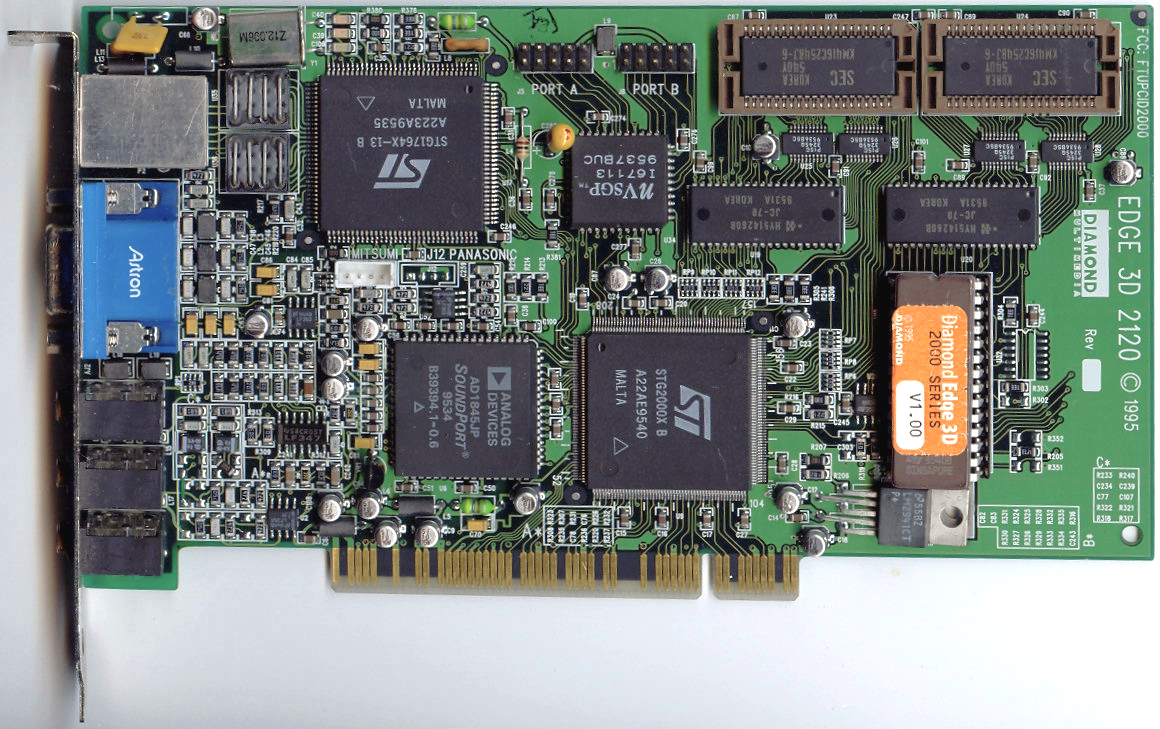 🇺🇸 United StatesNV1
Nvidia's first graphics accelerator with quadratic mapping and integrated audio.GPU · GPU architecture · 1995
More from NEC
All of them 🇯🇵 JapanNEC μPD7720
Fixed-point digital signal processor from NECDSP · VLIW · 1981
🇺🇸 United StatesIntel 8237
Four-channel DMA controller for early IBM PCsAnalog · Other · 1980
 🇯🇵 JapanNEC V20
Pin-compatible 16-bit microprocessor with Intel 8088 compatibilityCPU · x86 · 1982
 🇮🇱 IsraelIntel 8088
A 16-bit Intel microprocessor with an 8-bit external data bus, used in the original IBM PC.CPU · x86 · 1979