
Amiga custom chips
Support logic chips for Commodore Amiga computers
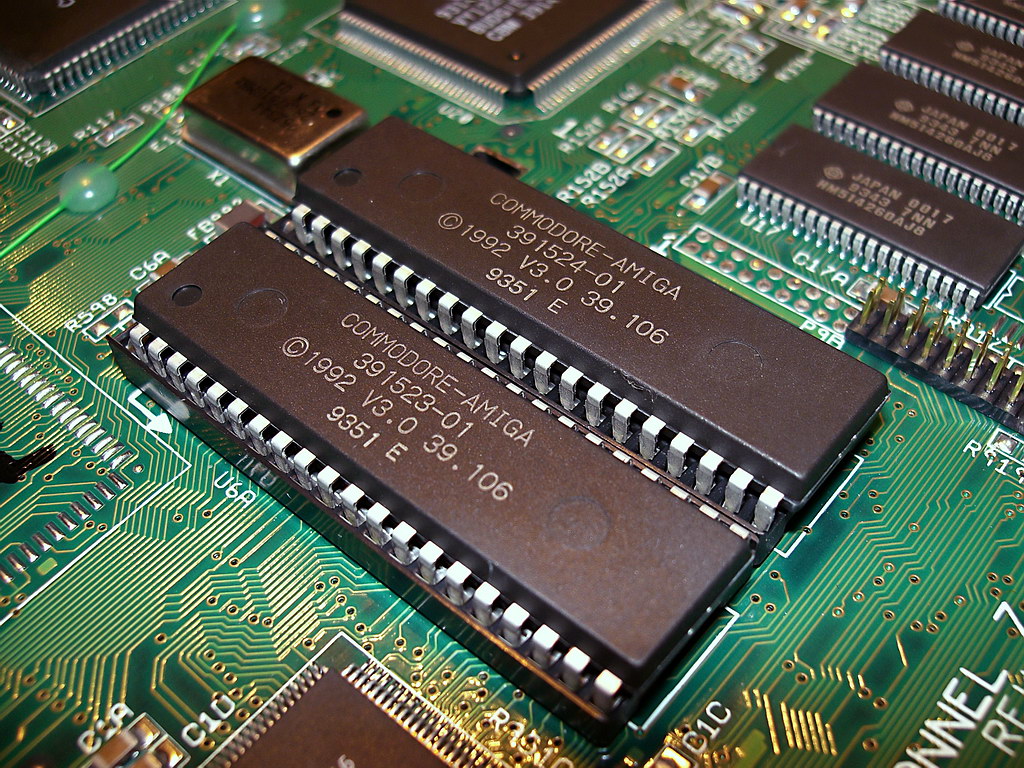
These are specialised integrated circuits used in Commodore Amiga systems. They handle system glue logic, bus control, memory management and video conversion. Designed to replace discrete components, they reduced costs and improved performance across various Amiga models.
- Akiko handles chunky-to-planar graphics conversion in hardware
- Super Buster manages Zorro II and III bus arbitration
- Gary replaced discrete logic in Amiga 500 and 2000
- Amber converts interlaced video to progressive format
- Ramsey controls on-board 32-bit Fast RAM banks
What it is
The Amiga custom chips refer to a collection of specialised integrated circuits used in Commodore Amiga computers. These components sit outside the core chipset but are essential for system operation. They manage tasks such as bus arbitration, direct memory access, and input/output interfacing. By integrating functions that were previously handled by separate discrete components, these chips helped lower manufacturing costs and simplify motherboard designs. Models include Gary, Gayle, Akiko, and Buster, each serving specific roles in different Amiga generations.
How it came about
Early Amiga models like the 1000 relied on many individual discrete chips for system logic. As the product line evolved, Commodore designed custom integrated circuits to consolidate these functions. The Gary chip appeared in the Amiga 500 and 2000 to handle glue logic and floppy drive support. Later models introduced updated versions like Fat Gary for 32-bit systems and Gayle for the A600. This progression aimed to reduce component count and improve reliability across the expanding range of Amiga hardware.
Inside the chip
These chips perform diverse architectural roles. Gary and Gayle manage bus control and peripheral interfaces. Akiko integrates system glue logic for the CD32, including CD-ROM control and graphics conversion from chunky to planar formats. Buster and Super Buster handle expansion bus arbitration for Zorro II and III slots. Memory controllers like Ramsey manage Fast RAM banks, while DMAC chips provide direct memory access for SCSI controllers. Video support chips such as Amber convert interlaced signals to progressive formats for higher resolution displays.
How it was made
Manufacturing details for these specific custom chips are not provided in the available records. They were produced for use in various Amiga models ranging from the 1000 to the 4000 series. Some chips, like the Vidiot, function as hybrid integrated circuits for digital-to-analog conversion. Others, such as the 8727 DMA, interface with external controllers like the WD33C93. The integration level varied, with some chips replacing dozens of discrete logic gates.
Where it went
These components were deployed across the Commodore Amiga lineup. Gary served the Amiga 500, 2000 and CDTV. Gayle was used in the A600 and A1200. Akiko was central to the CD32 console. Super Buster supported the A3000 and A4000 expansion buses. Video chips like Amber enabled high-resolution monitors and flicker fixers. SCSI adapters such as the A2090 utilized the 8727 DMA for data transfer. Each chip addressed specific hardware needs within its respective system configuration.
Versions and family
Several chips had multiple revisions. Super Buster existed in Level I and Level II variants, with later revisions fixing bus lockup bugs and adding DMA support. Ramsey and Super DMAC had specific version pairings required for stable operation. Fat Gary upgraded the original Gary for 32-bit architectures. Budgie connected trapdoor expansions in the A1200. Bridgette integrated bus buffers in the A4000 series, replacing multiple discrete logic chips from earlier designs.
Why it matters
These chips allowed Commodore to streamline Amiga motherboard designs. By consolidating discrete logic into single packages, they reduced production complexity and cost. Features like hardware chunky-to-planar conversion in Akiko improved 3D graphics performance without CPU overhead. Enhanced bus controllers like Super Buster enabled faster expansion capabilities. The integration of SCSI and floppy control logic simplified peripheral connectivity for users and developers alike.
Problems and reception
Some revisions faced technical issues. Super Buster Level II had a bug causing potential bus lockups. Certain combinations of Ramsey and Super DMAC revisions led to hard disk errors. Despite these quirks, the chips were pin-compatible, allowing for upgrades. The Akiko chip was praised for offloading graphics conversion tasks. Overall, these components were critical to the functionality and expandability of the Amiga platform.
Questions people ask about Amiga custom chips
What is the purpose of the Akiko chip?
Akiko serves as the main glue logic chip for the Amiga CD32. It manages CD-ROM control, system timers, and game ports. It also accelerates graphics by converting chunky pixel data to planar format in hardware, reducing CPU load during 3D operations.
How does Super Buster differ from Buster?
Buster controls the Zorro II expansion bus in older models. Super Buster supports both Zorro II and Zorro III subsystems in the A3000 and A4000. It has multiple revisions, with later versions adding DMA support and fixing compatibility bugs found in earlier levels.
What role does the Amber chip play?
Amber is a video buffer chip used in the A3000 and A2320 expansion. It stores alternate video fields in memory to convert interlaced output into a progressive format. This allows for stable display at higher scan frequencies, effectively doubling the vertical resolution perception.
Good reading and sources
The facts on this page come from the Wikipedia article "Amiga custom chips", written by its contributors and used under the CC BY-SA 4.0 licence, and from its Wikidata record (CC0). EveryChip rewrote the text in its own words, with AI assistance, and compares every page with the article to make sure no passage is copied. It may be reused under the same CC BY-SA 4.0 licence with a link back.
It may contain mistakes, and figures change over time. Nothing here is investment or buying advice. If something is wrong, tell us. Last refreshed 2026-11-14.
Like Amiga custom chips
All analog, power and mixed-signal World78xx
Family of fixed positive linear voltage regulator integrated circuitsAnalog
 🇺🇸 United StatesLM3914
Analog display driver for LED bar graphs and dot metersAnalog
 🇺🇸 United StatesLM358
Low-power dual operational amplifier for single-supply circuitsAnalog
 🇺🇸 United StatesLM386
Low-voltage audio power amplifier integrated circuitAnalog
