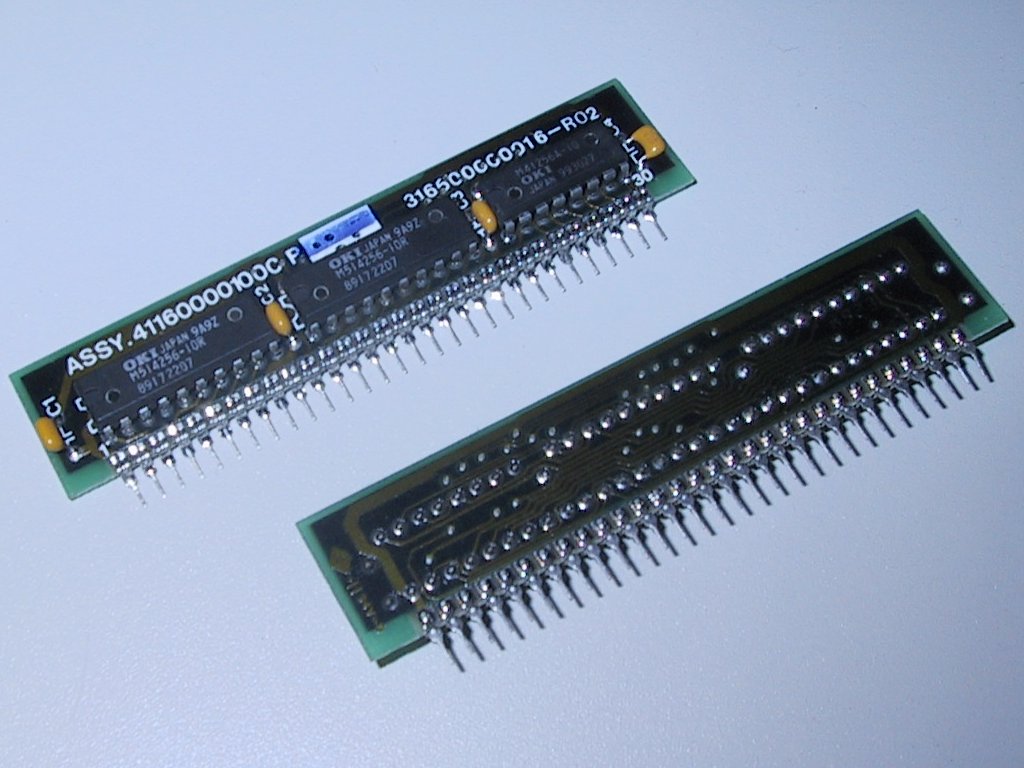
SIPP memory
Pin-based 30-pin memory module for early PCs
SIPP memory was a short-lived form of random-access memory used in some 80286 and 80386 computers. It featured pins that plugged into motherboard holes but was quickly replaced by more durable edge-connector SIMMs.
- Used in some 80286 and 80386SX systems
- Featured 30 pins along one edge
- Replaced by more durable edge-connector SIMMs
- Pin compatible with 30-pin SIMM modules
What it is
SIPP memory, standing for single in-line pin package or single in-line package, was a type of random-access memory module. It consisted of a small printed circuit board holding several memory chips. Along one edge, the module featured thirty pins designed to mate with matching holes on a computer motherboard. This format served as a brief variant of the more common thirty-pin SIMM technology before disappearing from the market.
How it came about
This memory format appeared during the era of 80286 and 80386SX systems. It offered a way to install RAM using pins rather than edge contacts. However, the design proved short-lived. Manufacturers and users soon favoured SIMMs that used edge connectors instead. These alternatives were found to be more economical to produce and more durable in use, leading to the rapid decline of the pinned version.
Inside the chip
The module used a thirty-pin layout along a single edge. These pins inserted directly into holes on the mainboard. The physical design allowed for pin compatibility with standard thirty-pin SIMM slots. Because of this compatibility, some SIPP modules were actually standard SIMMs with pins soldered onto their existing edge connectors. This adaptation allowed them to fit into boards designed for either format.
How it was made
The construction involved mounting multiple memory chips onto a small printed circuit board. The defining feature was the row of thirty metal pins attached to one side. No specific manufacturing process node or transistor count is recorded for these modules, as they were assemblies of existing memory chips rather than a single integrated circuit design.
Where it went
These modules found their place in certain personal computers based on the 80286 and 80386SX processors. They provided the system memory required for these early desktop machines. Their usage was limited to this specific window in PC history before the industry standardised on edge-connector SIMMs for broader compatibility and reliability.
Versions and family
The primary variant was the thirty-pin module. It existed alongside and was compatible with the thirty-pin SIMM. Some units were hybrid constructions, where pins were added to standard SIMM connectors. The format did not spawn a long line of successors, as it was itself replaced by the edge-connector SIMM design.
Why it matters
SIPP memory represents a transitional phase in PC memory expansion. It demonstrated an attempt to adapt SIMM technology for different motherboard layouts. Its quick replacement highlights the industry's preference for cost-effective and robust connection methods, cementing the edge-connector SIMM as the dominant standard for that generation of hardware.

Questions people ask about SIPP memory
What does SIPP stand for?
SIPP stands for single in-line pin package. It is also referred to as SIP or single in-line package. It describes a memory module with pins rather than edge contacts.
Which computers used SIPP memory?
This memory type was used in some systems based on the 80286 and 80386SX processors. It was a short-lived solution before edge-connector SIMMs became the standard.
Is SIPP compatible with SIMM?
Yes, thirty-pin SIPP modules were pin compatible with thirty-pin SIMM modules. Some SIPP units were actually SIMMs with pins soldered onto the connectors to fit both slot types.
Good reading and sources
The facts on this page come from the Wikipedia article "SIPP memory", written by its contributors and used under the CC BY-SA 4.0 licence, and from its Wikidata record (CC0). EveryChip rewrote the text in its own words, with AI assistance, and compares every page with the article to make sure no passage is copied. It may be reused under the same CC BY-SA 4.0 licence with a link back.
It may contain mistakes, and figures change over time. Nothing here is investment or buying advice. If something is wrong, tell us. Last refreshed 2026-11-14.
Like SIPP memory
All memory chips WorldDRAM
Volatile semiconductor memory using capacitors and transistors for high-density storage.Memory
 🇺🇸 United StatesPC100
Intel standard for reliable 100 MHz SDRAM modulesMemory
WorldPC133
Standard for 133 MHz synchronous dynamic RAM modulesMemory