
Larrabee
Cancelled Intel x86-based GPGPU project that became the Xeon Phi line
Larrabee was a cancelled Intel project for a discrete graphics processor built from many simple x86 cores, intended for games and general-purpose computing. Announced around 2008 and dropped as a consumer GPU in December 2009, its design ideas lived on in the Xeon Phi co-processors.
- Cancelled Intel discrete GPU mixing x86 cores with wide SIMD vector units
- 32 cores planned at 45 nm, with 24-core and 48-core variants discussed
- Each core: 512-bit vector unit, 256 KB L2, four interleaved threads
- Overclocked demo passed one teraFLOPS at SC09 in November 2009
- Design fed the Xeon Phi co-processors; consumer GPU plans ended May 2010
What it is
Larrabee was Intel's codename for a discrete graphics processor that mixed CPU and GPU traits. It used many small x86 cores with wide vector units and a shared cache, aiming to run games through Direct3D and OpenGL while also handling general-purpose computing such as ray tracing or physics. Intel planned a 2010 launch for a consumer graphics card, but delays and weak early results killed that plan. The project was dropped as a retail GPU in May 2010 and its technology moved into the Xeon Phi co-processor line.
How it came about
Hardware design came from a new group at Intel's Hillsboro, Oregon site, separate from the Nehalem team. Software and drivers were written by another new team, with the 3D stack handled by staff at RAD Game Tools, including Michael Abrash. Intel's Visual Computing Institute studied technologies for Larrabee products. A SIGGRAPH 2008 paper described simulated performance, and demos followed in 2009. On 4 December 2009 Intel said the first generation would not ship as a consumer GPU, and on 25 May 2010 it confirmed a high-performance computing product instead.
Inside the chip
Each core was a simple in-order x86 design derived from the P54C Pentium, updated with x86-64 support like the Atom Bonnell core. In-order execution lowers single-core speed but lets more cores fit on one die. Every core had a 512-bit vector unit handling 16 single-precision floats at once, plus scatter/gather and mask registers. Texture sampling units did trilinear and anisotropic filtering. A 1024-bit ring bus linked cores and memory. Cores shared a coherent cache, each with 256 KB of L2, and ran four interleaved threads. Software did z-buffering, clipping and blending in a tile-based renderer.
How it was made
A June 2007 report expected 32 cores on a 45 nm process in late 2009, with 24-core parts sold when yields left defective cores. A shrink to 32 nm was planned for a 48-core version in 2010. The successor Knights Corner was slated for 22 nm. Theoretical peak for a 32-core part at 2 GHz was 2 TFLOPS, counting 16 floats per core and two FLOPs per fused multiply-add.
Where it went
Larrabee was meant for a consumer 3D graphics card and for general-purpose tasks such as ray tracing and physics, in games or scientific work. A ray-traced version of Enemy Territory: Quake Wars ran live at the Intel Developer Forum in San Francisco on 22 September 2009, with reflective water. At SC09 in Portland on 17 November 2009, Intel CTO Justin Rattner showed an overclocked part passing one teraFLOPS, reaching 1006 GFLOPS in an SGEMM 4Kx4K test.
Versions and family
The first generation became a development platform rather than a product. Knights Ferry was the prototype card, and Knights Corner a 22 nm production part planned for 2012 or later under the Intel MIC brand. Later Intel discrete GPUs, Xe in September 2020 and Arc in March 2022, came from a separate effort begun in June 2018 and were not based on Larrabee work.
Why it matters
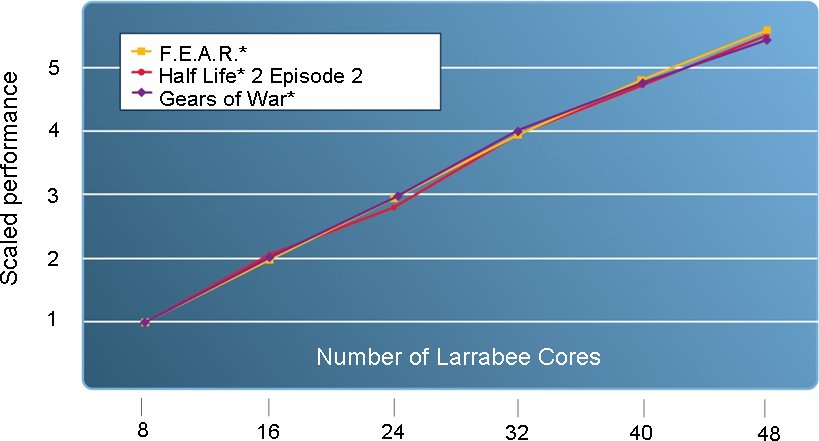
Larrabee never shipped as a graphics card, but its many-core x86 approach fed the Xeon Phi line aimed at high-performance computing against Nvidia Tesla. Simulations suggested near-linear scaling to 32 cores at 60 frame/s in 1600x1200 games, dropping to 90 percent of that trend at 48 cores. The project showed how far x86 vector hardware could be pushed for throughput work.
Problems and reception
Rivals were sceptical. At NVISION 08 an Nvidia staff member dismissed Intel's SIGGRAPH paper as marketing puff and cited analyst Peter Glaskowsky comparing the design to a 2006 GPU. Intel said prototypes matched the GeForce GTX 285 by June 2009, yet the teraFLOPS demo reached only a fifth of shipping boards, so the discrete GPU was cancelled. A 2018 review of an engineering sample by Linus Sebastian got no video output, while a 2022 demo by Roman "der8auer" Hartung showed display output but no 3D acceleration without drivers.
Questions people ask about Larrabee
What was Larrabee meant to be?
A discrete graphics card for PCs, using many small x86 cores instead of a traditional GPU design. It was intended to run games through Direct3D and OpenGL and also to handle general-purpose computing such as ray tracing or physics simulations.
Why was it cancelled?
Hardware and software slipped behind schedule and early performance looked weak. Intel dropped the consumer product on 4 December 2009 and confirmed on 25 May 2010 that the effort would become a high-performance computing part instead.
How did its cores differ from normal Intel CPUs?
They were simple in-order designs based on the old P54C Pentium, updated with x86-64. Each had a 512-bit vector unit for 16 floats at a time, and four threads per core to hide stalls, trading single-thread speed for throughput.
What replaced it?
The technology passed to the Intel MIC line, starting with the Knights Ferry prototype and the planned 22 nm Knights Corner, sold as Xeon Phi co-processors for high-performance computing against Nvidia Tesla.
Is it related to Intel Arc?
No. Intel revived the idea of a discrete GPU in June 2018, leading to Xe in 2020 and Arc in 2022, but those products were unrelated to the Larrabee project.
Good reading and sources
- SearchIntel, Article
- Checking your browserAnandTech, Article
- Intel's Larrabee GPU put on ice, more news to come in 2010Ars Technica, Article
The facts on this page come from the Wikipedia article "Larrabee (microarchitecture)", written by its contributors and used under the CC BY-SA 4.0 licence, and from its Wikidata record (CC0). EveryChip rewrote the text in its own words, with AI assistance, and compares every page with the article to make sure no passage is copied. It may be reused under the same CC BY-SA 4.0 licence with a link back.
It may contain mistakes, and figures change over time. Nothing here is investment or buying advice. If something is wrong, tell us. Last refreshed 2026-11-14.
Like Larrabee
All graphics processors 🇺🇸 United StatesXeon Phi
Intel's x86 manycore coprocessor family for supercomputers and HPCCPU · x86 · 2010
🇺🇸 United StatesTiger Lake
11th generation mobile processors from Intel using Willow Cove coresCPU · x86 · 2020
🇺🇸 United StatesGulftown
Intel's six-core 32 nm desktop and server processor, sold as Core i7 and XeonCPU · x86 · 2010
 🇺🇸 United StatesAMD APU
AMD chips combining CPU and GPU on one dieCPU · x86 · 2011
More from Intel
All of them 🇺🇸 United StatesPlatform Controller Hub
Intel single-chip chipset for I/O controlAnalog · 2009