
ETRAX CRIS
Embedded RISC processors by Axis Communications
Axis Communications designed the ETRAX CRIS series of system-on-chip processors for embedded systems starting in 1993. These chips integrate networking controllers and central processing units to support devices like network cameras and print servers.
- Designed and made by Axis Communications since 1993
- ETRAX 100LX draws a maximum of 0.35 Watts
- Support for Linux kernel dropped in version 4.17
- Integrates Ethernet, CPU and I/O on one chip
What it is
The ETRAX CRIS is a family of system-on-chip processors developed by Axis Communications. First released in 1993, these chips combine a central processing unit with networking interfaces such as Ethernet. The name stands for Ethernet, Token Ring, AXis, and Code Reduced Instruction Set. They are built specifically for embedded applications where integrated communication hardware is required. Early models included support for Token Ring networks, though this feature was removed in later versions as the technology became obsolete. The series allows manufacturers to build compact devices with robust connectivity options without needing separate controller chips.
How it came about
Axis Communications began its processor development with the CGA-1 Coax Gate Array, which handled IBM coaxial communications. Designers Martin Gren and Staffan Göransson created this initial microcontroller. In 1993, the company launched the ETRAX-1 Ethernet Controller. This evolved into the ETRAX-4 system-on-chip in 1995, adding a CPU and memory interface. The ETRAX 100 followed in 1997 with faster Ethernet and SCSI support. By 2000, the ETRAX 100LX arrived with USB and SDRAM capabilities. The ETRAX FS model appeared in 2005, offering full Linux 2.6 support and cryptographic accelerators. Support for the architecture was dropped from the main Linux kernel in version 4.17 due to obsolescence.
Inside the chip
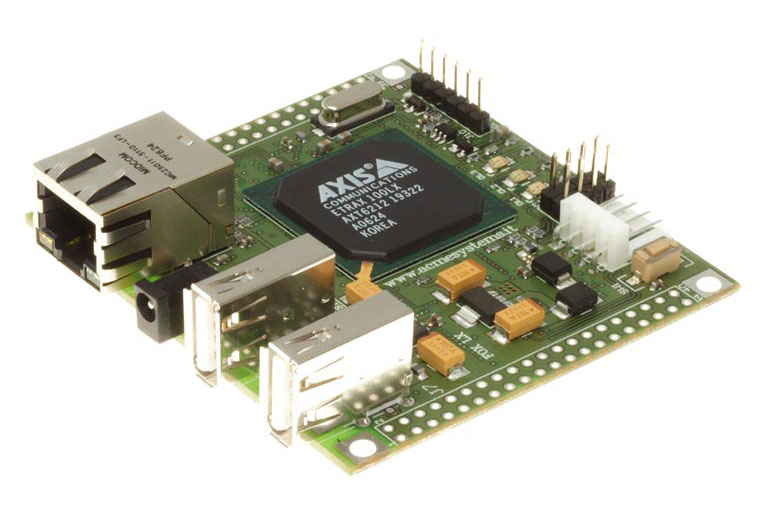
These processors use a 32-bit RISC core known as CRIS. The architecture integrates various input and output controllers directly onto the silicon. Early chips featured unified instruction and data caches along with direct memory access. The ETRAX 100LX model includes a memory management unit and can execute 100 million instructions per second. It supports multiple serial ports, USB connections, and ATA interfaces. Later models like the ETRAX FS increased performance to 200 MIPS and added 16 kB of cache. They also include dedicated hardware for encryption standards such as AES and SHA-1. This integration reduces the need for external components in embedded designs.
How it was made
Axis Communications designs and manufactures these chips internally. The production process details such as specific node sizes are not publicly detailed in the provided records. The ETRAX 100LX MCM variant packages the processor with internal flash memory and SDRAM. This multi-chip module approach simplifies board design by combining storage and processing in one unit. Configurations include 2 MB or 4 MB of flash paired with 8 MB or 16 MB of SDRAM. The chips are optimized for low power consumption, with the ETRAX 100LX drawing a maximum of 0.35 Watts.
Where it went
These processors are primarily used in embedded systems that require network connectivity. Common applications include network-attached storage, print servers, and IP cameras. The ability to run the Linux kernel makes them suitable for complex embedded tasks. The ETRAX 100LX can run Linux with only minor low-level modifications. The ETRAX FS supports newer Linux versions and handles cryptographic tasks, making it useful for secure communications equipment. Their integrated Ethernet and USB controllers reduce the bill of materials for device manufacturers.
Versions and family
The series started with the ETRAX-1 and ETRAX-4. The ETRAX 100 introduced 10/100 Mbit/s Ethernet and Wide SCSI. The ETRAX 100LX added USB and SDRAM support. The ETRAX 100LX MCM variant integrates memory directly. The ETRAX FS is a later model with higher speed and crypto acceleration. The predecessor to the ETRAX line was the CGA-1 chip. Linux kernel support ended with version 4.17, marking the end of active mainstream software maintenance for the architecture.
Why it matters
The ETRAX series enabled Axis Communications to build highly integrated network devices. By combining the CPU and network controllers, they reduced the complexity and cost of embedded hardware. The chips supported the growth of networked peripheral devices in the 1990s and 2000s. Their compatibility with Linux allowed developers to use open-source software in embedded products. This helped establish a standard for how network-enabled embedded systems could be architected.
Questions people ask about ETRAX CRIS
What does the name ETRAX stand for?
The name is an acronym for the chip's key features: Ethernet, Token Ring, AXis, and Code Reduced Instruction Set. Token Ring support was removed in later models as it became obsolete.
Can these chips run Linux?
Yes, the ETRAX 100LX can run the Linux kernel with minimal changes. The later ETRAX FS model supports Linux 2.6 fully. However, mainline Linux support was removed in kernel version 4.17.
Who designed the first chip in this lineage?
The predecessor CGA-1 chip was designed by Martin Gren and Staffan Göransson at Axis Communications. It handled IBM coaxial communications before the ETRAX series began.
Good reading and sources
The facts on this page come from the Wikipedia article "ETRAX CRIS", written by its contributors and used under the CC BY-SA 4.0 licence, and from its Wikidata record (CC0). EveryChip rewrote the text in its own words, with AI assistance, and compares every page with the article to make sure no passage is copied. It may be reused under the same CC BY-SA 4.0 licence with a link back.
It may contain mistakes, and figures change over time. Nothing here is investment or buying advice. If something is wrong, tell us. Last refreshed 2026-11-14.
Like ETRAX CRIS
All systems on a chip 🇺🇸 United StatesPowerPC 400
Embedded 32-bit RISC processor cores for diverse applicationsCPU · Power · 1994
🇬🇧 United KingdomARC
Configurable RISC processor cores for embedded systems and SoCs.CPU · RISC · 1996
 🇯🇵 JapanFR-V
Fujitsu VLIW and vector processor for imagingCPU · VLIW · 1999