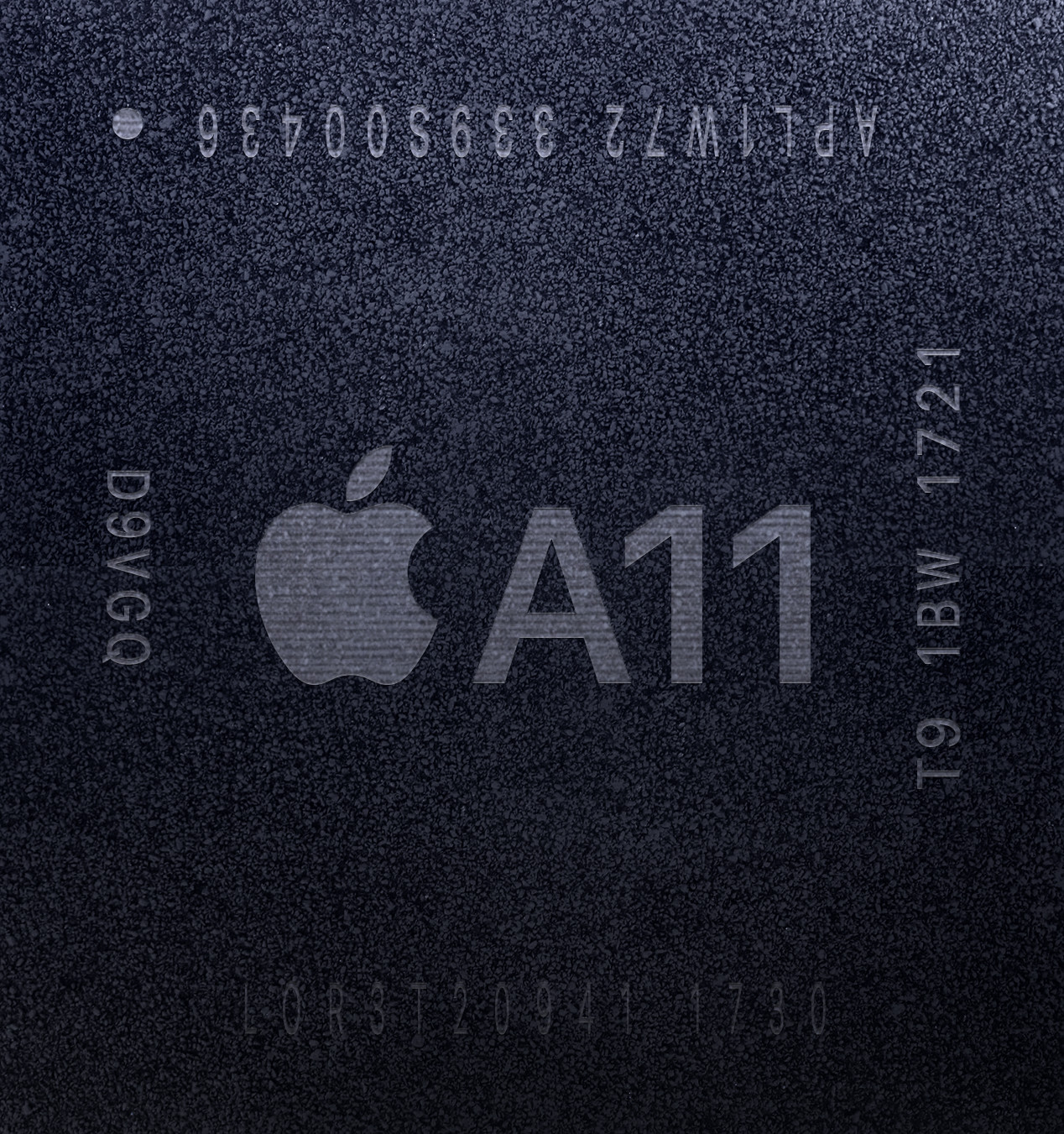
Apple A11 Bionic
A six-core ARM system on a chip designed by Apple and manufactured by TSMC for iPhones.
The Apple A11 Bionic is a mobile system on a chip designed by Apple Inc. and made by TSMC using a 10 nm process. It powered the iPhone 8, 8 Plus and iPhone X from September 2017 until production ended in April 2020.
- Six-core CPU with two Monsoon and four Mistral cores
- First Apple chip with a dedicated Neural Engine
- Manufactured by TSMC using a 10 nm FinFET process
- Contains 4.3 billion transistors on an 87.66 mm² die
- Powered iPhone 8, 8 Plus and iPhone X models
What it is
The Apple A11 Bionic is a mobile system on a chip designed by Apple Inc. and manufactured by TSMC. It belongs to the Apple silicon series and uses a 10 nm process. The chip was introduced on September 12, 2017, alongside the iPhone 8, 8 Plus and iPhone X. It features a six-core CPU and a dedicated neural engine for machine learning tasks. Production ended on April 15, 2020, after the iPhone 8 models were discontinued.
How it came about
Apple designed the A11 Bionic as part of its ongoing shift to custom ARM-based processors. The chip marked a significant step in integrating artificial intelligence capabilities directly into mobile devices. Apple recruited AI experts like Russ Salakhutdinov in October 2016 to support these efforts. The Neural Engine was developed to handle machine learning tasks more efficiently than the main CPU or GPU could alone. This hardware allowed features like Face ID and Animoji to function with improved energy efficiency.
Inside the chip
The A11 Bionic contains a six-core CPU built on the ARMv8-A architecture. It uses two high-performance Monsoon cores running at 2.39 GHz and four energy-efficient Mistral cores. The Monsoon cores feature a seven-wide decode out-of-order superscalar design, while the Mistral cores use a three-wide decode design based on earlier Swift cores. A new performance controller allows all six cores to operate simultaneously. The chip also includes a three-core GPU and an M11 motion coprocessor. Image processing supports computational photography functions such as wide color capture.
How it was made
TSMC manufactured the A11 Bionic using a 10 nm FinFET process. The die measures 87.66 mm² and contains 4.3 billion transistors. This transistor count represents a significant density increase over previous designs. The chip is packaged using Package on Package technology. It is combined with either 2 GB or 3 GB of LPDDR4X memory depending on the device model. The die size is approximately 30% smaller than that of its predecessor.
Where it went
The Apple A11 Bionic was exclusively used in Apple's iPhone lineup. It powered the iPhone 8, iPhone 8 Plus and iPhone X models released in 2017. These devices relied on the chip for general computing, graphics rendering and machine learning tasks. The Neural Engine supported specific features like Face ID authentication and Animoji animations. Third-party applications could not access the Neural Engine hardware directly.
Versions and family
The Apple A11 Bionic succeeded the Apple A10 Fusion chip. It was followed by the Apple A12 Bionic in subsequent iPhone generations. The chip shares its core design language with other Apple silicon processors but remains distinct in its integration of the first-generation Neural Engine. No iPad, iPod touch or Apple TV models utilised this specific processor variant.
Why it matters
The introduction of the Neural Engine represented a major shift in mobile computing architecture. It enabled on-device machine learning for features like facial recognition and augmented reality. This hardware innovation influenced how smartphone manufacturers approached artificial intelligence integration. The chip demonstrated the viability of dedicated AI accelerators in consumer electronics. Its design principles carried forward into later Apple silicon generations.
Problems and reception
The A11 Bionic received attention for its integrated Neural Engine capabilities. However, third-party developers could not utilise the dedicated neural hardware. This limitation restricted the performance benefits of the Neural Engine to Apple's own applications. Users experienced improved functionality for features like Face ID and Animoji without external software support.

Questions people ask about Apple A11 Bionic
What is the Apple A11 Bionic?
It is a mobile system on a chip designed by Apple Inc. and manufactured by TSMC. It features a six-core ARM-based CPU and a dedicated Neural Engine for machine learning tasks. The chip was used in the iPhone 8, 8 Plus and iPhone X.
When was the Apple A11 Bionic released?
The chip was introduced on September 12, 2017. It accompanied the launch of the iPhone 8, 8 Plus and iPhone X. Production continued until April 15, 2020 when the associated iPhone models were discontinued.
How many cores does the A11 have?
The A11 Bionic contains six CPU cores. Two are high-performance Monsoon cores running at 2.39 GHz. Four are energy-efficient Mistral cores based on Apple's earlier Swift core design. All cores can operate simultaneously thanks to a new performance controller.
What is the Neural Engine in the A11?
The Neural Engine is dedicated hardware for machine learning tasks. It performs up to 600 billion operations per second. It enables features like Face ID and Animoji with improved energy efficiency. Third-party apps cannot access this hardware directly.
Good reading and sources
- Checking your browserAnandTech, Article
- iPhone X confirmed to have 3GB of RAM and 2,716mAh batteryThe Verge, Article
- Apple Is Working on a Dedicated Chip to Power AI on DevicesBloomberg, Article
The facts on this page come from the Wikipedia article "Apple A11", written by its contributors and used under the CC BY-SA 4.0 licence, and from its Wikidata record (CC0). EveryChip rewrote the text in its own words, with AI assistance, and compares every page with the article to make sure no passage is copied. It may be reused under the same CC BY-SA 4.0 licence with a link back.
It may contain mistakes, and figures change over time. Nothing here is investment or buying advice. If something is wrong, tell us. Last refreshed 2026-11-15.
Like Apple A11 Bionic
All systems on a chip 🇺🇸 United StatesApple A10X Fusion
64-bit ARM system on a chip for iPad Pro and Apple TVSoC · Arm · 2017
🇺🇸 United StatesApple A11 Bionic
Six-core phone SoC with a Neural Engine, used in iPhone 8 and iPhone XSoC · Arm · 2017
More from Apple Inc.
All of them WorldEpyc
AMD's server and embedded x86-64 CPUs built on Zen coresCPU · x86 · 2017
 🇺🇸 United StatesAMD Instinct
AMD's data centre GPU line for deep learning and HPCGPU · GPU architecture · 2017
🇺🇸 United StatesZen
AMD's processor microarchitecture family behind Ryzen, Threadripper and Epyc chipsCPU · x86 · 2017
 🇺🇸 United StatesApple T2
Security and controller SoC for Intel-based MacsSoC · Arm · 2017