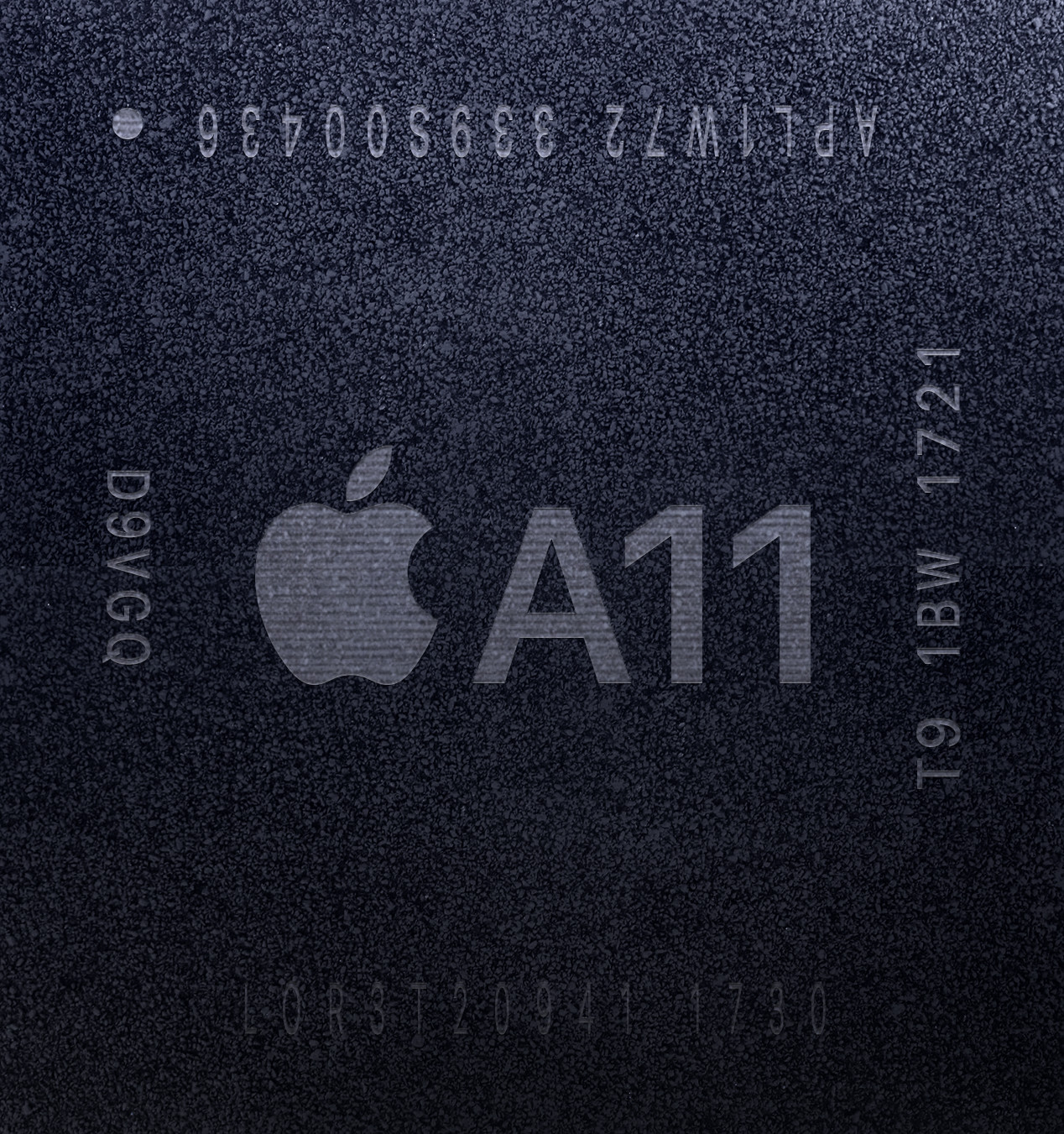
Apple A11 Bionic
Six-core phone SoC with a Neural Engine, used in iPhone 8 and iPhone X
A mobile system on a chip that Apple designed and TSMC built on a 10 nm process, carrying six CPU cores, a three-core GPU and dedicated neural network hardware. It arrived with the iPhone 8, 8 Plus and iPhone X in September 2017 and stayed in production until April 2020.
- Six CPU cores: two Monsoon at 2.39 GHz, four Mistral
- 4.3 billion transistors on an 87.66 mm2 die at 10 nm
- Neural Engine rated at up to 600 billion operations per second
- All six cores can run at once, unlike the A10
- Shipped in iPhone 8, 8 Plus and iPhone X only
What it is
Apple's A11 Bionic is a system on a chip, meaning a single piece of silicon that gathers the main processor, graphics and several helper units together. It runs the 64-bit ARMv8.2-A instruction set and belongs to the Apple silicon line. Apple drew up the design while TSMC manufactured the parts. Phones carrying it reached shops on 12 September 2017, and the chip itself left production on 15 April 2020. Its standout feature was a block of neural network circuitry, branded the Neural Engine, which handled machine learning work far more cheaply than the CPU or GPU could.
How it came about
Apple built the A11 as the follow-up to the A10 Fusion and A10X Fusion. The company claimed sizeable speed gains over the A10: 25% for the two fast cores and up to 70% for the four frugal ones. A second-generation performance controller arrived with this chip, letting every core run at once, something the A10 could not manage. Bloomberg linked the Neural Engine to Apple's push to strengthen its AI group after a 2015 report said the firm's secrecy made recruiting researchers hard. Russ Salakhutdinov joined as director of AI research in October 2016.
Inside the chip
The CPU holds six cores split into two kinds. Two Monsoon cores chase speed, decoding seven instructions per cycle and running out of order at 2.39 GHz. Four Mistral cores save power, decoding three per cycle; their lineage traces back to Swift, the core Apple used in the A6. Cache memory sits close to the cores: 64 KB for instructions and 64 KB for data at the first level, with 8 MB shared at the second. Graphics come from an Apple three-core GPU, roughly 30% quicker than the A10's. An M11 motion coprocessor and a fresh image processor handle sensor data and computational photography, including lighting estimation and wide colour capture.
How it was made
TSMC produced the A11 on its 10 nm FinFET line. The die measures 87.66 mm2 and packs 4.3 billion transistors, about 30% less area than the A10. Chips ship in a package on package arrangement, with LPDDR4X memory stacked alongside: 2 GB in the iPhone 8, 3 GB in the iPhone 8 Plus and iPhone X.
Where it went
Only three phones carried the A11: the iPhone 8, iPhone 8 Plus and iPhone X, all unveiled on 12 September 2017. No iPad, iPod touch or Apple TV generation used it. Inside those handsets it drove Face ID, Animoji and other machine learning features through the Neural Engine, and handled video work with HEVC and H.264 encoding plus HEVC, H.264, MPEG-4 Part 2 and Motion JPEG decoding. iOS 16, which arrived in 2022, was the final major system release for these devices.
Versions and family
The A11 sits between the A10 Fusion and A10X Fusion on one side and the A12 Bionic and A12X Bionic on the other. Its two core types were named Monsoon and Mistral, and the part number APL1W72 identifies it. Apple paired the same chip with different memory amounts depending on the handset.
Why it matters
The Neural Engine gave Apple in-house silicon for machine learning, cutting the energy cost of tasks such as Face ID and Animoji compared with running them on the CPU or GPU. Bloomberg treated the block as evidence of Apple's renewed investment in AI research, alongside hiring and published papers. The chip also showed Apple could run all six cores together, a step beyond the A10.
Problems and reception
Third-party developers could not reach the Neural Engine, so outside apps saw neural network performance close to that of older iPhones. Beyond that restriction, the record notes the chip's speed claims over the A10 and its retirement alongside the iPhone 8 models in April 2020.

Questions people ask about Apple A11 Bionic
What kind of chip is the A11 Bionic?
It is a system on a chip for phones. Apple designed it and TSMC built it. One piece of silicon carries the CPU, a three-core GPU, a motion coprocessor, an image processor and a Neural Engine, along with cache memory.
How many cores does it have?
Six processor cores in two groups. Two Monsoon cores handle demanding work at 2.39 GHz, while four Mistral cores take lighter tasks to save battery. A performance controller lets all six operate together.
What does the Neural Engine do?
It is dedicated circuitry for neural network maths, rated at up to 600 billion operations per second. Face ID, Animoji and other machine learning jobs use it because it draws less power than the CPU or GPU. Outside developers could not access it.
Which devices used this chip?
Just three: the iPhone 8, iPhone 8 Plus and iPhone X, all introduced on 12 September 2017. No iPad, iPod touch or Apple TV model carried it. The chip was discontinued on 15 April 2020.
How was it manufactured?
TSMC made it on a 10 nm FinFET process. The die is 87.66 mm2 and holds 4.3 billion transistors, around 30% smaller than the A10. It ships in a package on package with 2 GB or 3 GB of LPDDR4X memory stacked on top.
Good reading and sources
- Checking your browserAnandTech, Article
- iPhone X confirmed to have 3GB of RAM and 2,716mAh batteryThe Verge, Article
The facts on this page come from the Wikipedia article "Apple A11", written by its contributors and used under the CC BY-SA 4.0 licence, and from its Wikidata record (CC0). EveryChip rewrote the text in its own words, with AI assistance, and compares every page with the article to make sure no passage is copied. It may be reused under the same CC BY-SA 4.0 licence with a link back.
It may contain mistakes, and figures change over time. Nothing here is investment or buying advice. If something is wrong, tell us. Last refreshed 2026-11-14.
Like Apple A11 Bionic
All systems on a chip 🇺🇸 United StatesApple A10X Fusion
64-bit ARM system on a chip for iPad Pro and Apple TVSoC · Arm · 2017
🇨🇳 ChinaXiaomi Surge and Xring
In-house system-on-chips and specialized silicon for Xiaomi devices.SoC · Arm · 2017
More from Apple Inc.
All of them WorldEpyc
AMD's server and embedded x86-64 CPUs built on Zen coresCPU · x86 · 2017
 🇺🇸 United StatesAMD Instinct
AMD's data centre GPU line for deep learning and HPCGPU · GPU architecture · 2017
🇺🇸 United StatesZen
AMD's processor microarchitecture family behind Ryzen, Threadripper and Epyc chipsCPU · x86 · 2017
 🇺🇸 United StatesApple T2
Security and controller SoC for Intel-based MacsSoC · Arm · 2017