
Bulldozer
AMD microarchitecture for desktop and server processors released in 2011.
Bulldozer is a processor microarchitecture developed by AMD for desktop and server markets. Released in October 2011, it introduced a modular design with shared resources to improve efficiency in high-performance computing tasks.
- Released in October 2011 for desktop and server markets.
- Uses a modular design with shared floating-point units.
- Manufactured on GlobalFoundries 32 nm SOI process.
- Supports AVX, AES, and FMA4 instruction sets.
- Settled a false advertising lawsuit for $12.1 million.
What it is
Bulldozer is a microprocessor architecture created by Advanced Micro Devices for desktop and server computers. It launched in October 2011 as the successor to the K10 design. The architecture targets high-performance computing with a focus on power efficiency. It supports instruction sets like AVX and AES, aiming to balance dedicated and shared hardware resources for better scaling.
How it came about
This design marked the first major overhaul of AMD processor architecture since 2003. Engineers built it from scratch rather than evolving previous models. The goal was to eliminate redundant elements in multicore designs to save power and increase unit count. It utilized GlobalFoundries 32 nm Silicon on Insulator process technology. The launch included desktop chips codenamed Zambezi and server processors named Interlagos and Valencia.
Inside the chip
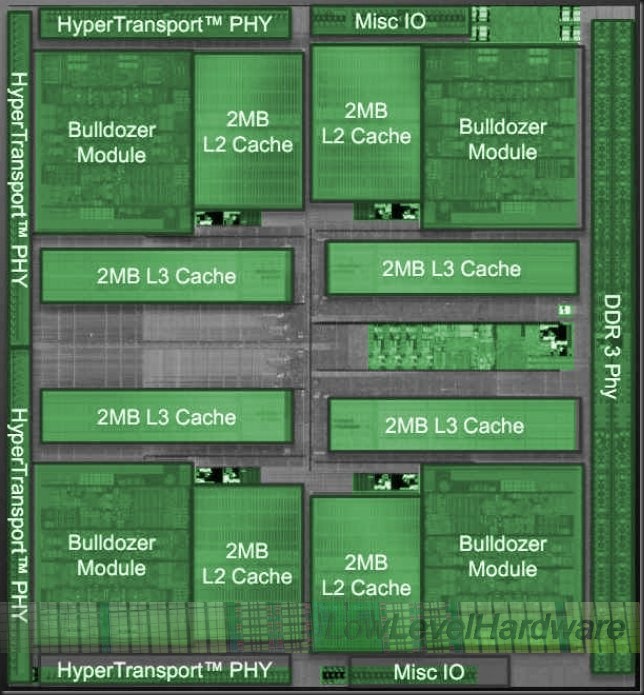
The core concept is a module containing two integer clusters that share early pipeline stages and floating-point units. Each module has two dedicated integer cores but one shared flexible floating-point unit. This approach, called Clustered Multithreading, allows efficient resource use during mixed workloads. The pipeline depth is 20 cycles, enabling higher clock speeds than the predecessor. Shared L2 cache and a write coalescing buffer help manage data flow between the paired cores.
How it was made
GlobalFoundries manufactured the chips using a 32 nm Silicon on Insulator process with High-k Metal Gate technology. Each module contains 213 million transistors within an area of roughly 31 square millimeters. The design supports voltage levels between 0.775 and 1.425 volts. Turbo Core technology allows frequency boosts up to 1 GHz when half the threads are active, staying within thermal limits.
Where it went
Desktop users found these processors in the AMD FX series, such as the FX-4100 and FX-8150, using Socket AM3+. Server environments deployed Opteron 4200 and 6200 series chips for workstations and data centers. These servers used Socket C32 or G34. The architecture aimed at applications requiring high thread counts, though single-threaded performance often lagged behind contemporary Intel rivals.
Versions and family
The family includes desktop variants like Zambezi and server lines Valencia and Interlagos. Interlagos supports up to eight modules for sixteen cores. Piledriver followed as the second-generation refinement. Excavator, the fourth generation, added AVX2 support. The initial release featured four, six, and eight-core configurations for different market segments.
Why it matters
The architecture faced criticism for lower than expected performance in single-threaded tasks. Reviews noted it trailed behind Intel Sandy Bridge and even AMD own previous Phenom II in some benchmarks. This contributed to significant financial losses for AMD in 2012. However, the modular concept influenced future designs, and the company eventually returned to profitability through later architectures like Ryzen.
Problems and reception
Critics highlighted poor single-threaded speed and high power consumption under load. A class-action lawsuit filed in 2015 alleged false advertising regarding core counts, claiming modules were not true dual-cores. AMD settled the suit in 2019 for 12.1 million USD. Early Linux tests showed modest gains, while Windows benchmarks revealed inconsistencies compared to rival products.

Questions people ask about Bulldozer
What is the main design feature of Bulldozer?
It uses a modular architecture where two integer cores share a floating-point unit and L2 cache. This approach, known as Clustered Multithreading, aims to improve efficiency by reducing redundant hardware components.
Which manufacturing process was used for Bulldozer chips?
GlobalFoundries produced the chips using a 32 nanometer Silicon on Insulator process with High-k Metal Gate technology. This allowed for specific power and frequency targets within the thermal design limits.
Why did Bulldozer face criticism upon release?
Reviewers found its single-threaded performance weaker than expected, often trailing behind Intel Sandy Bridge and AMD own previous K10 architecture. High power consumption under load also drew negative comments from testers.
Did Bulldozer support AVX instructions?
Yes, the architecture supports Advanced Vector Extensions for 256-bit floating-point operations. It also includes SSE4.1, SSE4.2, AES, and AMD-specific extensions like FMA4 and XOP for enhanced computational capabilities.
Good reading and sources
- Checking your browserAnandTech, Article
- AMD sued over allegedly misleading Bulldozer core countArs Technica, Article
- AMD’s Bulldozer And Bobcat Architectures Pave The WayTom's Hardware, Article
- Bulldozer (microarchitecture) on WikipediaEncyclopedia
- More photos on Wikimedia CommonsPhotos
- Wikidata recordOpen data
The facts on this page come from the Wikipedia article "Bulldozer (microarchitecture)", written by its contributors and used under the CC BY-SA 4.0 licence, and from its Wikidata record (CC0). EveryChip rewrote the text in its own words, with AI assistance, and compares every page with the article to make sure no passage is copied. It may be reused under the same CC BY-SA 4.0 licence with a link back.
It may contain mistakes, and figures change over time. Nothing here is investment or buying advice. If something is wrong, tell us. Last refreshed 2026-11-14.
Like Bulldozer
All CPUs and microprocessors 🇺🇸 United StatesPiledriver
Second-generation AMD x86 microarchitecture for desktops and serversCPU · x86 · 2012
🇺🇸 United StatesExcavator
AMD's final Bulldozer-derived x86-64 microarchitectureCPU · x86 · 2015
 🇺🇸 United StatesPOWER9
IBM's Power ISA server microprocessor family, built on 14 nm FinFET siliconCPU · Power · 2016
 🇺🇸 United StatesRyzen
AMD's multi-core x86-64 CPU brand built on the Zen microarchitectureCPU · x86 · 2016
More from AMD
All of them 🇺🇸 United StatesAMD FX
High-end desktop CPUs with unlocked multi-core designs from AMD.CPU · x86 · 2011
 🇺🇸 United StatesBobcat
Low-power x86 microarchitecture for AMD APUsCPU · x86 · 2011
 🇺🇸 United StatesAMD APU
AMD chips combining CPU and GPU on one dieCPU · x86 · 2011
 WorldAMD 900 chipset series
Chipset family for Socket AM3+ desktop processorsAnalog · 2011